
A wrist with an Apple Watch resting in low warm light.

Acute Stress Marker · RMSSD explained

RMSSD,
explained honestly.

The HRV number that moves first when something's off. What RMSSD actually measures, how your Apple Watch records it, and why Body Insights reads it as the acute stress marker — not a score to chase.

Get Body Insights Free for core features.

The number that moves before you feel it.

Three nights before a cold lands, before a flare you couldn't yet name — something in the rhythm of your heartbeat narrows. The intervals between beats stop varying the way they used to. The body has registered the strain. You haven't.

That narrowing has a name. RMSSD — the root mean square of successive differences between heartbeats — is the HRV metric that captures it earliest. Of the standard short-term HRV measures, it responds most quickly to acute stress, which is why Body Insights reads it as your acute stress marker.

This page is the long-form version. For the daily read, see stress monitoring. To understand what's underneath it, keep going.

A woman by a window in soft morning light, looking at her wrist.
A woman seated on a sofa in soft daylight, calm and unhurried.

What RMSSD actually measures.

Your heart doesn't beat like a metronome. The interval between one beat and the next changes slightly with every breath, every shift in posture, every passing thought. That variation is heart rate variability, and the size of the beat-to-beat variation is what RMSSD captures.

Mathematically: take the difference between each pair of consecutive heartbeats, square those differences, average them, then take the square root. The result is reported in milliseconds. A higher RMSSD means more beat-to-beat variation. A lower RMSSD means the intervals are clustering close together — the heart is being held on a shorter leash.

That leash is the vagus nerve. RMSSD is the cleanest non-invasive read on parasympathetic (vagal) tone we have. When the parasympathetic system is engaged — rest, digestion, recovery — RMSSD goes up. When it pulls back — illness, late dinner, alcohol, real stress, hormonal shifts — RMSSD comes down.

Where the standard comes from.

RMSSD isn't a wearable-era invention. It was defined as a standard short-term HRV measure in 1996, by the joint Task Force of the European Society of Cardiology and the North American Society of Pacing and Electrophysiology. Their paper, Heart rate variability: standards of measurement, physiological interpretation, and clinical use, is still the reference document the entire field anchors to.

The Task Force named three time-domain HRV measures worth tracking: SDNN, RMSSD, and pNN50. Of those, RMSSD was singled out as the one that responds fastest to short-term parasympathetic changes — and the one most robust to short recording windows, which is exactly the situation a wearable is in overnight.

That's why Body Insights anchors on it. The math has been settled for three decades. The wrist is new; the metric isn't.

Why RMSSD drops first.

When the immune system activates — for any reason, viral, bacterial, inflammatory — one of the earliest responses is a suppression of vagal tone. Cytokines released during the inflammatory cascade act on the brainstem and on the heart itself, dampening parasympathetic activity. The heart's variability narrows.

This happens before the fever. Before the sore throat. Often a night or two before any conscious symptom. Which is why a sustained drop in RMSSD against your own baseline is one of the most useful early signals a wearable can surface.

The same pattern shows up in non-illness contexts. A poor night of sleep. A heavy training day. A perimenopausal hot-flash night. A flare day in a chronic condition. Each one pushes RMSSD down, because each one calls on the parasympathetic system to back off.

That's why we treat RMSSD as the acute marker. It moves on a timescale of days. The slower trends — fitness, age, structural change — show up in SDNN and in your longer baseline. The thing that changed this week shows up here first.

Tea by a window, a book set down, a quiet moment of rest.
Read your RMSSD tomorrow morning

Free for core features. No card needed.

For people who want the science.

Everything below is what an honest write-up of RMSSD on a wrist wearable should tell you — including where the wrist falls short.

How Body Insights reads RMSSD from your Apple Watch.

Body Insights doesn't measure your heart. Your Apple Watch does. We read what it wrote to Apple Health and translate it.

Raw beat-to-beat intervals

Apple Watch records a stream of inter-beat intervals (HKHeartbeatSeries) during sleep and quiet windows. We read that stream rather than Apple's default SDNN summary, which means the RMSSD you see is computed from raw data — not derived from another statistic.

Overnight window

The cleanest read is during sleep, when posture and breathing are stable and the parasympathetic system is doing its primary work. We compute RMSSD across the overnight window for consistency night to night.

Interval filtering

Wrist photoplethysmography occasionally records intervals that don't reflect real heartbeats — motion artefacts, signal gaps. We discard intervals outside a physiologically plausible range before the calculation runs.

Your own baseline

After two to three weeks of nights, we have enough of your own data to build a personal baseline distribution. Every subsequent night is read against that distribution — not against a textbook number.

Percentile, not just z-score

Personal HRV distributions are often skewed, especially in chronic illness. We use percentile rank against your own history alongside z-scores, so an unusual night gets flagged correctly even when your distribution isn't bell-shaped.

Plain-language output

You don't have to read the number. The morning insight is a sentence: "Your acute stress marker dropped against your baseline overnight. Today, take it slow." The score is there if you want it.

Wrist versus chest strap: the honest version.

A chest-strap ECG is the consumer reference standard for HRV. It picks up the heart's electrical signal directly, and for a single short measurement under controlled conditions, it is more accurate than any wrist photoplethysmographic device on the market — Apple Watch included.

The wrist trades that single-reading precision for two things the chest strap can't give you: it stays on all night, and it stays on every night, without a ritual. Recent validation work comparing nocturnal RMSSD from Apple Watch (using the raw heartbeat-series data we read) against chest-strap reference devices shows good agreement on trend across weeks. Single-night agreement is reasonable but noisier — especially when wrist contact is poor or movement is high.

The practical consequence: if you want a competition-grade measurement of one morning's RMSSD, use a chest strap and the protocol that comes with it. If you want a sustained signal that catches an illness coming three nights early, or a flare building over a week, the wrist wins — because it actually shows up.

Body Insights leans into that trade. We read RMSSD as a pattern across nights, not as a verdict on any single one.

Apple Watch resting on a kitchen counter in morning light.

RMSSD vs SDNN vs the HRV number on your watch.

Three different things often called "HRV." Worth distinguishing, because they answer different questions.

RMSSD SDNN Apple HRV (default)
What it capturesBeat-to-beat variationOverall variance across windowSDNN over short reads
ReflectsParasympathetic (vagal) toneMixed autonomic activityMixed autonomic activity
Best forAcute / short-term changeLonger-term structural changeCasual trend chart
Window neededShort (minutes)Longer (ideally 24 hr)Whatever the watch sampled
In Body InsightsAcute stress markerBackground contextAvailable but not the primary read

The Task Force named both RMSSD and SDNN as standard time-domain measures. They're not redundant — they answer different questions. RMSSD is what we surface when something's changed this week.

What moves RMSSD around — and what doesn't.

Useful to know before you read a low number and worry.

Things that pull it down

Poor sleep, alcohol the night before, late or heavy dinner, infection or pre-symptomatic illness, intense training the day before, perimenopausal hot flashes, anxiety, dehydration, autonomic dysfunction in chronic conditions.

Things that pull it up

Consistent sleep, aerobic fitness, slow breathing practice before bed, hydration, an unusually restorative night. Some of these are choices; some aren't. None of them are an instruction.

What it does not measure

RMSSD is not a measure of how hard you're working, how fit you are in absolute terms, your VO2max, or your readiness as a single concept. It's a window onto vagal tone. Other inputs carry the rest.

Why a low day is rarely the answer

Single-night variation is real. One night below baseline often means nothing — you slept poorly, you had wine. A sustained drop across multiple nights is the signal worth reading.

It's a signal. Not a target.

You will not find anywhere on this page the phrase "boost your RMSSD." That framing is wrong on two counts.

First, RMSSD is a window onto your nervous system, not a muscle to train. The things that move it sustainably are sleep, fitness, and not being chronically ill — none of which are gameable. Chasing the number itself produces the kind of pseudo-discipline that wearable culture has made famous and that does not survive contact with an actual chronic condition.

Second, and more practical: when RMSSD drops, the appropriate response is usually to do less, not to drill protocols designed to push it back up. The drop is the body telling you it's busy. The intervention is rest, food, and patience. The number recovers when the underlying state recovers — not before.

So we surface the signal. We tell you what changed. We don't hand you a score to optimise.

A walking path in autumn light, unhurried.

Questions you're probably asking.

What is RMSSD?

The root mean square of successive differences between heartbeats. A time-domain HRV measure that reflects vagal (parasympathetic) tone, named as a standard by the Task Force in 1996.

Is RMSSD the same as Apple Watch HRV?

No. Apple Watch reports SDNN by default. Body Insights computes RMSSD from the raw beat-to-beat data Apple Watch records overnight.

How accurate is wrist RMSSD?

For trends across one to four weeks, good. For a single reading versus a chest-strap ECG, less precise — wrist photoplethysmography is noisier than a chest electrical signal, especially with movement.

What is a normal RMSSD?

There isn't one. Healthy adults range roughly 20–80 ms, falling with age and rising with fitness. Chronic-illness baselines often run lower. Your own baseline is what matters.

Why does RMSSD drop before I feel sick?

Inflammatory signalling suppresses vagal tone early in immune activation — often a night or two before symptoms. The drop is a leading indicator, not a diagnosis.

Where do I see this in the app?

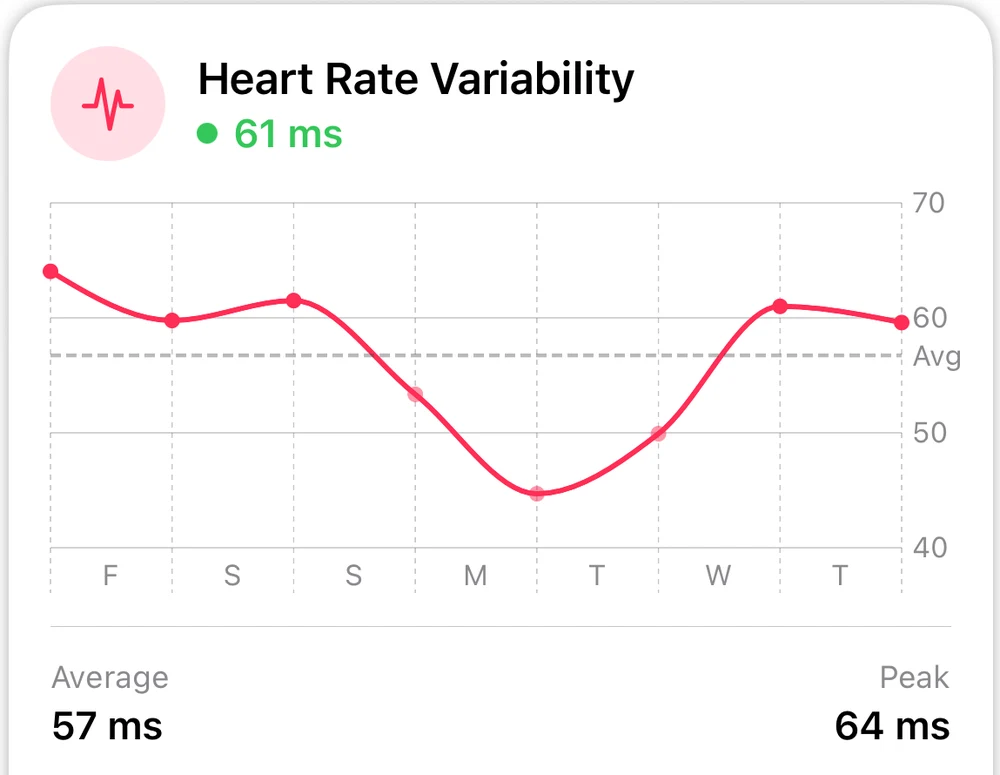
Your morning insight names it when it changes. Detail views show the overnight trend against your own baseline. For the daily read, see stress monitoring.

Your HRV data stays yours.

On-device. No account. No subscription required. No data sold. Ever.

  • Reads from Apple Health
  • Stays on your iPhone
  • You choose what to share
A phone resting on a nightstand at dusk, quiet light.

Read your acute stress marker tomorrow morning.

Free for core features. No card needed.

A woman in soft morning light, calm and unhurried.