HRV decline (SDNN)
Overall autonomic tone falling - one of the earlier signals in the chain. Tends to show 2-3 days before symptoms.
Illness Predictor · Resting heart rate early warning
When your resting heart rate climbs and your HRV drops, Body Insights reads the pattern from your Apple Watch. It usually flags the change 2-3 days before symptoms arrive.
iPhone + Apple Watch. Reads from Apple Health. Free for core features.
A resting heart rate that drifts a few beats above your normal is one of the earliest things a body does when it's mounting an immune response. Your Apple Watch already records it overnight. Most apps just don't read it as a signal.
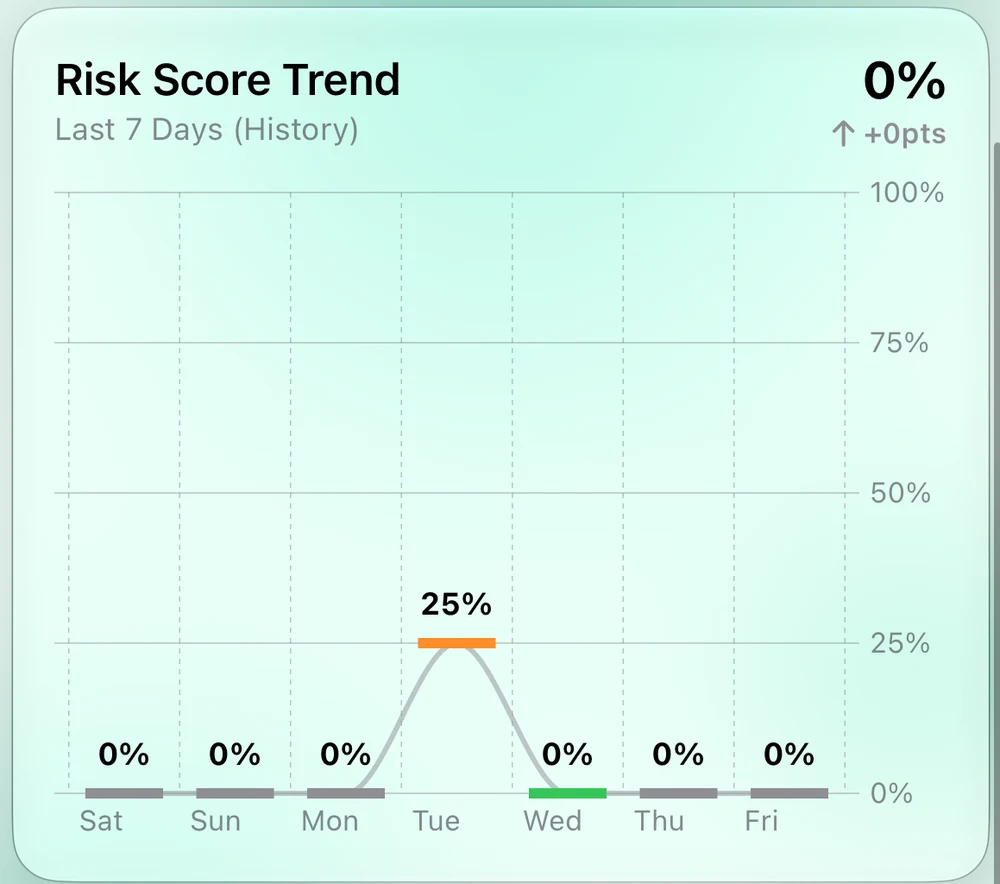
You've probably felt the moment. Tuesday morning your watch shows 64. By Wednesday it's 68 and you can't quite say why. Nothing in the day explains it. Two days later you wake up with a sore throat, and the chart, in retrospect, was already telling the story.
Resting heart rate is the most under-read number on your wrist. Small upward shifts above your own baseline tend to show up days before the symptoms catch up. The pattern is quiet. The cost of missing it is loud.
Built for people with ME/CFS, Long COVID, chronic Lyme, chronic EBV, fibromyalgia, or POTS. It also supports autoimmune flares, perimenopause, recovery after illness, and anyone who pays the cost when they push through.
The signals don't arrive all at once. They drift - quietly, together - across the days before symptoms land.
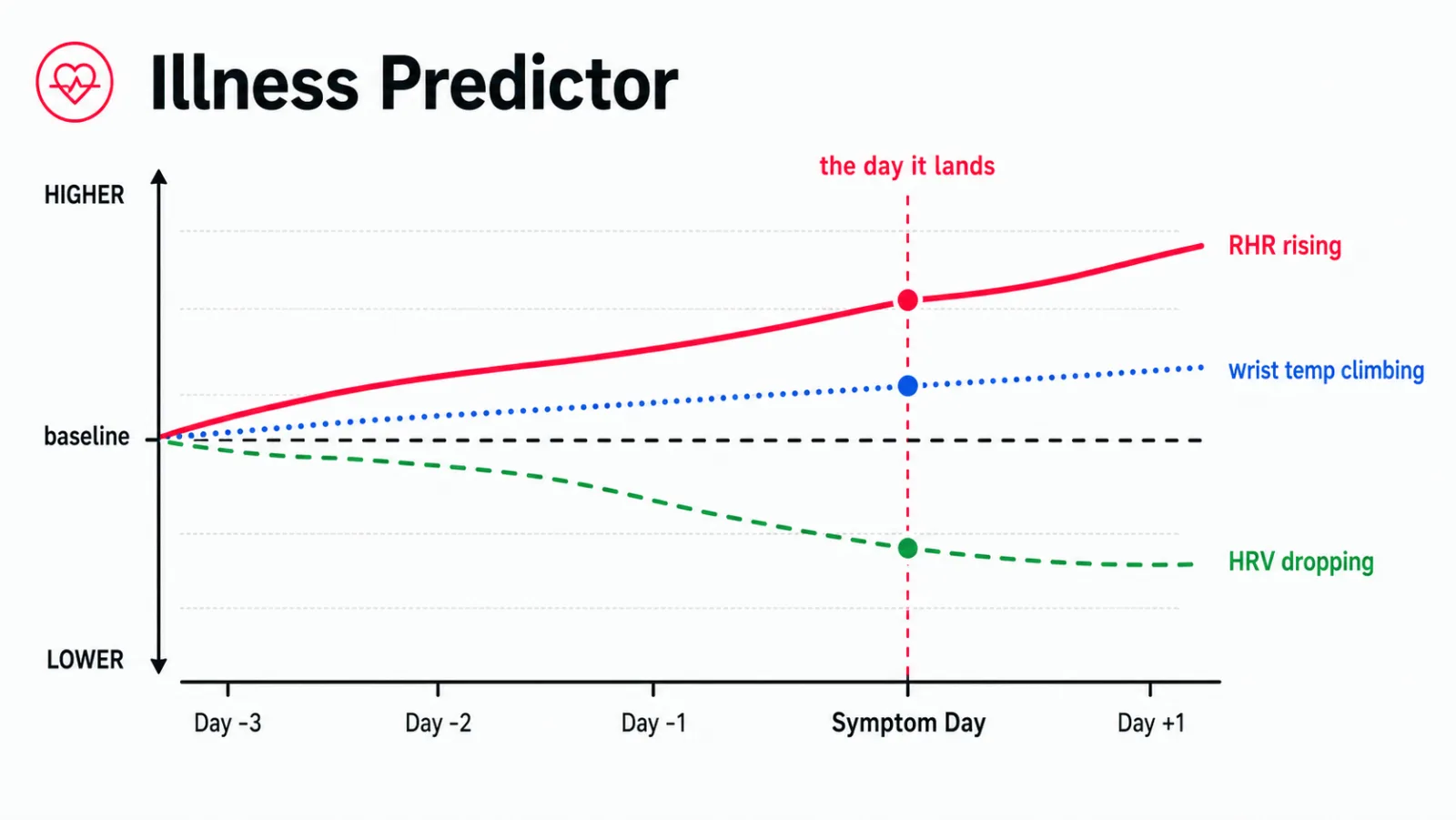
By the time your throat is sore, your body may have shown changes for a while. Resting heart rate may drift up. HRV may ease down. Wrist temperature may rise above its overnight normal.

Several signals shift in the days before illness - and your Apple Watch is already recording most of them. Body Insights reads them together and turns the pattern into a plain-language flag.
No single signal tells the story on its own. Heart rate can rise after a late dinner. HRV can drop after a hard run. The point of reading several together is that one outlier is noise - but two or three moving in the same direction is signal.
Two days before a cold, the chart is usually quiet on the surface and busy underneath. Body Insights reads the shape of the past week, not yesterday's number, so the pattern shows up early.
A typical read 48 hours out reads something like: "Resting heart rate is 6 bpm above your 14-day baseline. HRV has dropped below your usual range. Wrist temperature is slightly above your sleeping median. Worth taking it easy today."
Two things matter here. The reads are framed against your own baseline, not a population average - what's normal for one person is a warning for another. And the language is plain. "Take it easy." Not a score you have to translate.
Free for core features. No card needed.
The biology that catches a cold also catches an autoimmune flare, an EBV reactivation, a long-COVID relapse, or a POTS bad-week. The signals don't know what's causing the immune activation. They just know something has shifted.
For people living with ME/CFS, Long COVID, chronic Lyme, chronic EBV, fibromyalgia, POTS, or autoimmune conditions, the value of a 2-3 day lead is different. It isn't "skip the gym." It's the difference between catching a flare while there's still room to pace, and getting flattened by one.
Many people in this audience have spent years learning that overdoing it on a Monday is paid for on Wednesday and Thursday. Reading the early signal is what makes pacing possible.
Important: we don't diagnose. We surface a pattern. Body Insights isn't a medical device. It can't tell you whether the shift is a virus, a flare, perimenopausal disruption, or a hard training week. What it can do is hand you a pattern early enough to bring to your doctor, or to your own decision about what today can hold.

Everything below is what an honest early-warning read should tell you. If you're comparing approaches or weighing the research, you're in the right place.
Reads heart, breathing, and temperature data from Apple Health - the same data your Apple Watch already writes there overnight.
Overall autonomic tone falling - one of the earlier signals in the chain. Tends to show 2-3 days before symptoms.
The beat-to-beat measure of parasympathetic withdrawal. A short-window signal that often shows 1-2 days out.
Subtle overnight elevation above your sleeping baseline. Read as a deviation, not an absolute fever number.
A rise relative to your own normal range - the most under-read number on your wrist when you're getting sick.
A deviation from your typical overnight rate. A near-term signal that tends to show closer to symptom onset.
Heart rate response shifting against your usual workload - what your heart is doing for the same effort.
Each signal is read against your own baseline, with outlier days filtered out so a sick day doesn't quietly poison the next week's read. The combined pattern is what becomes the flag - never any single number.
The science underneath this read is recent and still developing. We're going to be honest about what's settled and what isn't.
RHR and infection. Studies used consumer wearables during the COVID-19 period. These included Fitbit and Apple Watch cohorts from the Scripps and Stanford groups. They found that resting heart rate can rise before symptoms in a meaningful share of cases. Quer and colleagues' 2021 paper in Nature Medicine is often cited. Reported sensitivity and specificity vary by study and cohort.
HRV and immune activation. Research by Thayer, Lane, and others covers the neurovisceral integration model. It connects parasympathetic withdrawal with immune and inflammatory signaling. The directional finding is well established. The exact lead time for any individual is not.
Wrist temperature. Research since 2021 has also studied overnight temperature rises as an early sign of illness. This work includes validation studies of consumer wearables.
Where the research is early, we say so. Where a claim is contested or population-dependent, we note it. The 2-3 day lead-time figure is a typical finding, not a guarantee - your body's signals are your body's, and they don't always read the script.

You're probably here because one approach didn't quite fit. So:
| Apple Watch alone | Oura | Body Insights | |
|---|---|---|---|
| RHR & HRV recorded | Yes | Yes | Yes (reads from your watch) |
| Wrist temperature | Yes (sleep) | Yes | Yes (reads from your watch) |
| Multi-signal illness flag | No | Partial | Yes - six signals together |
| Tuned for chronic illness baselines | No | No | Yes |
| Plain-language alert | No | Partial | Yes |
| Subscription | None | ~$6 / month | Free for core |
| Extra hardware | None | Ring required | None |
Apple Watch records the signals. It doesn't combine them into an early-warning read. Oura has a similar feature and builds it with care. Its baseline assumptions are set for healthy adults. They may not fit a body with low HRV from a chronic condition. Body Insights reads the same wrist data through a different lens.
| Before Body Insights | With Body Insights |
|---|---|
| RHR is up 5 bpm. You don't know what it means. | "Six signals are shifting together. Worth taking it easy today." |
| You push through Tuesday. Pay for it Thursday. | You catch the pattern Tuesday morning, before the cost lands. |
| Apple Watch records the signals. Nothing reads them. | Six signals read together, against your own baseline, summarized in one sentence. |
A virus brewing, a hard workout still being processed, alcohol the night before, dehydration, poor sleep, a hot bedroom, hormonal shifts. A single high day usually isn't a signal. A trend across three or four days - especially with HRV falling alongside - is.
Apple Watch records the signals that shift before illness - RHR, HRV, wrist temperature, respiratory rate. On its own it doesn't combine them. Body Insights reads all six together and flags the pattern, typically 2-3 days before symptoms.
HRV usually drops before symptoms, sometimes by 2-3 days. Overall HRV (SDNN) tends to fall. The beat-to-beat parasympathetic measure (RMSSD) may fall too. These changes can occur as the autonomic nervous system shifts into immune-response mode.
The same six signals may also shift before other immune events. These include an autoimmune flare, an EBV reactivation, or a long-COVID relapse. The pattern recognition can apply to these events too.
No. Body Insights surfaces patterns from data your Apple Watch already collects. We don't diagnose, we don't treat, and we don't replace your doctor. A persistent or alarming pattern is worth bringing to a clinician.
No CGM needed - this read is built on heart, breathing, and temperature data from the watch. Free for core features, including the illness read. Premium adds deeper analytics.
Your heart rate, HRV, wrist temperature, respiratory data - all stays on your phone. No login, no cloud, no third-party sharing.
We don't diagnose. Body Insights surfaces patterns - it isn't a medical device, and it doesn't replace your clinician. If a pattern is persistent or alarming, that's a conversation worth having with a doctor.

Free for core features, including the illness read. iPhone + Apple Watch.
