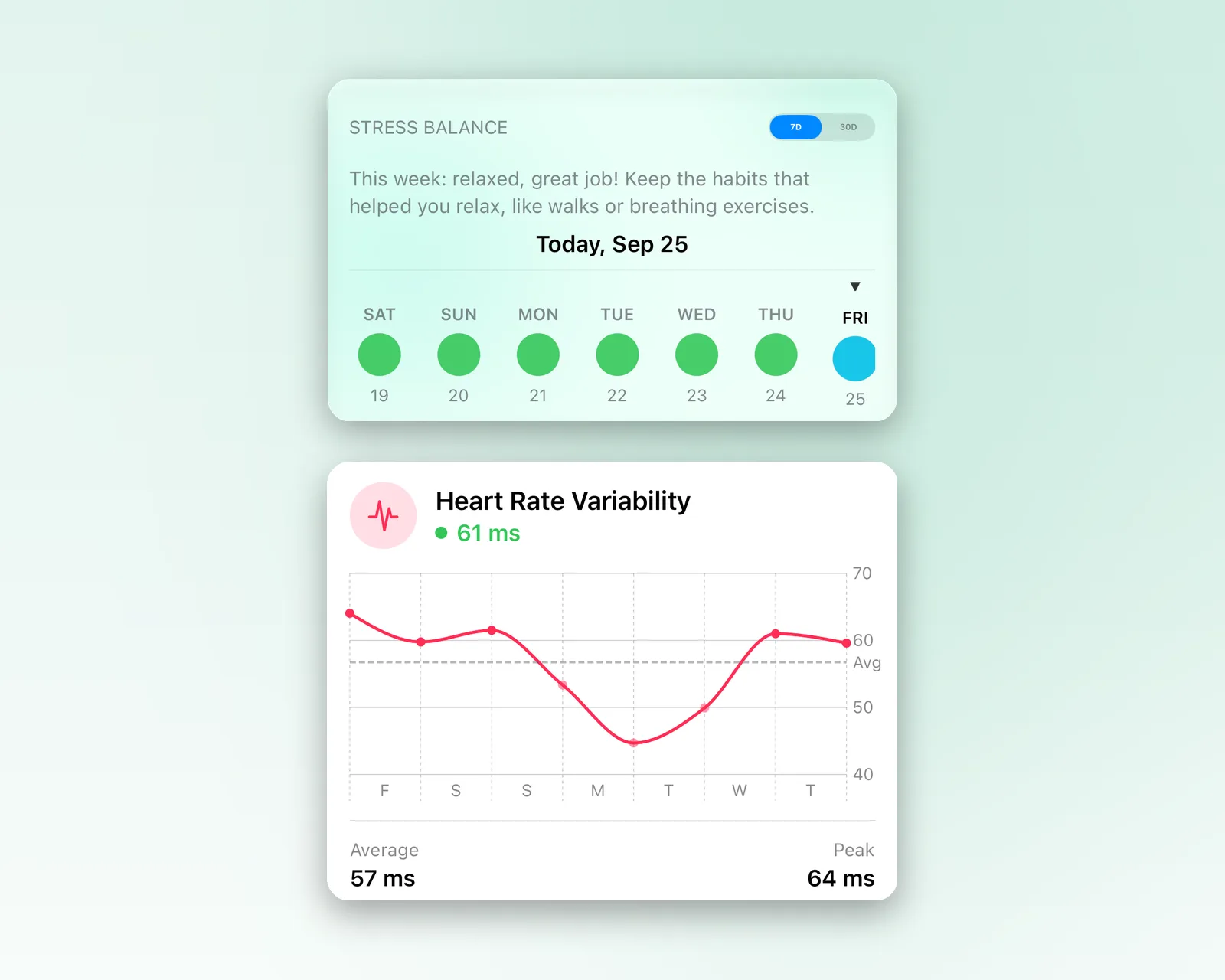
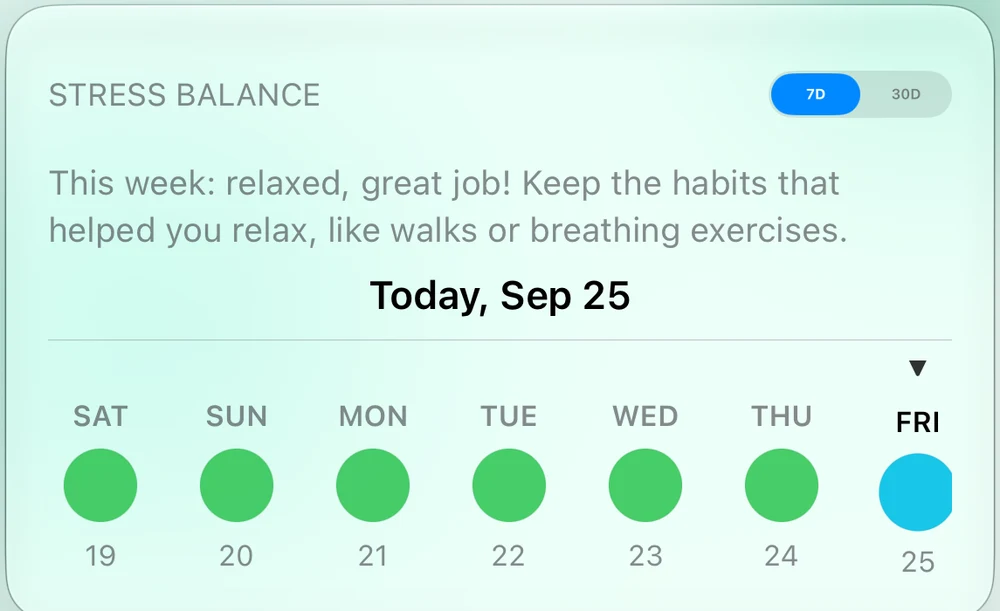
Daily stress label
Restful, Moderate, Stressed. Calculated against your own personal percentiles, not absolute population thresholds.
Stress Monitoring · Apple Watch HRV
Your Apple Watch reads your heart rate variability every night. Body Insights is the Apple Watch HRV app that reads the trend - and tells you, in plain language, what to do with it.
iPhone + Apple Watch. Free for core features.
A single day's HRV is noise. The trend is the signal. Your baseline is yours - not a 30-year-old runner's, not a textbook average.
You've probably opened the Health app, seen your HRV at 24ms, and felt something tighten in your chest. Or seen it at 58ms after a bad night and wondered why the number didn't match how you felt. Both can happen on the same body in the same week. HRV moves with sleep, hormones, alcohol, position, hydration, the time of measurement, even the mood you fell asleep in.
The number on a single morning is rarely the story. What your HRV is doing across two weeks, against your own normal, almost always is.

HRV is the millisecond variation between consecutive heartbeats. Higher variation generally means your parasympathetic nervous system is active. This is the "rest and recover" side. Lower variation means the sympathetic "alert and ready" side is doing more.
Apple Watch records HRV as RMSSD (root mean square of successive differences), measured in short windows, mostly while you're still or asleep. RMSSD is the metric the cardiology literature treats as the cleanest readout of vagal tone. It's also the most sensitive to acute stress, which is why it can swing day to day.
Keep two things in mind. Higher HRV generally means more parasympathetic activity and a lower stress load. The relationship is inverse. Your baseline is also personal. A "good" HRV for one person is 80ms. For another it's 22ms. Comparison across people is mostly meaningless. Comparison against yourself over time is useful.
Free for core features. No card needed.
Everything below is what an honest Apple Watch HRV app should tell you. If you're comparing tools - or trying to understand why your number looks the way it does - you're in the right place.
We pull every HRV sample your Apple Watch writes to Apple Health. We use it to build a 90-day personal baseline. Then we describe today against that baseline in plain language. The 90-day window matters. Short windows over-react to one bad night. Population averages ignore who you are.
Restful, Moderate, Stressed. Calculated against your own personal percentiles, not absolute population thresholds.
How many hours of your day landed in low-stress HRV territory vs high. Useful for spotting days that looked calm on the calendar but weren't, physiologically.
Recalculated on a rolling basis so the read keeps up with you. If your HRV is climbing back from a flare, the baseline rises with it.
A moving average laid over daily values so noise stops driving anxiety. The shape of two weeks is the read.
The window we lean on hardest. Stillness and sleep give the cleanest readings - and they're already happening, no morning ritual required.
One sentence in the morning. "HRV held above your average for the third night running. Worth noticing what's been going well."
If your HRV looks low compared to the charts online, it's worth knowing: those charts were almost never built on bodies like yours. We calibrate to your baseline, not a healthy-athlete one.
People with ME/CFS or Long COVID often have HRV values that would alarm an athlete's coach. The same can be true with POTS, dysautonomia, autoimmune flares, or post-viral recovery. Research on autonomic dysfunction in these conditions shows a common pattern. Vagal tone is often blunted. Sympathetic tone is often elevated. The baseline can sit below population norms.
That doesn't make the metric useless for you. It means the absolute number was never the point. A flare day reads as a meaningful drop from your own baseline - not "still in the red zone." A recovery week shows up as a quiet climb you'd otherwise miss. The day-to-day jitter that used to feel like proof of decline becomes what it actually is - noise.
Pacing isn't a failure of effort. It's the plan. The HRV read is here to inform it, not to grade it.


For trends across a week or a month, yes - Apple Watch RMSSD shows good agreement with chest-strap and ECG references in recent validation work. For any single 60-second reading against a lab, expect some disagreement. Read it as a pattern signal, not a verdict.
Apple Watch samples HRV opportunistically - mostly during stillness and sleep. Overnight readings are typically the most stable and the most useful for trend work. Daily variation of 10-20% from your baseline is normal. Research on RMSSD variation within one person supports this. A single low day is rarely meaningful. Three or four low days in a row is.
This is exactly the lens Body Insights uses. Single nights are data points. The two-week shape is the read.
A few of the studies underneath the read. Where the work is early, we say so. Where it's contested, we say that too. This is health content - over-claiming costs trust we don't get back.
Thayer and Lane's neurovisceral integration model links HRV to a brain and vagus nerve pathway. This system helps you adapt to your situation. It remains a widely cited basis for reading HRV as more than a heart number. (Thayer & Lane, 2000; updated 2009.)
Lehrer, Vaschillo, and colleagues studied slow breathing at about 6 breaths per minute. Their work shows that it raises HRV in the short term. The effects vary with dose and repeat across populations.
Validation work since 2023 shows good agreement with chest-strap RMSSD trends in healthy adults. There is less validation in people with chronic illness. We state that gap because the research is not settled.
Apple Watch is a strong passive HRV reader. The gap most people hit isn't the data - it's that nothing translates it. You're probably here because one of these tools didn't quite fit. Here is how the options differ.
| Apple Health | Elite HRV / HRV4Training | Whoop / Oura | Body Insights | |
|---|---|---|---|---|
| Reads from Apple Watch | Yes | Partial / morning ritual | No (own hardware) | Yes |
| Personal baseline | No | Yes | Yes | Yes (90-day) |
| Plain-language summary | No | Partial | Partial | Yes |
| Tuned for chronic illness | No | No | No | Yes |
| Morning chest-strap required | No | Often yes | No | No |
| Subscription | None | Free or paid | $6-30 / month | Free for core |
| Extra hardware | None | Optional strap | Ring or strap | None |
Whoop, Oura, and Elite HRV are good tools built by careful people. They serve athletes who tune training load and people who track optimization. They also suit people willing to measure each morning. Body Insights is for bodies that do not follow a training cycle. It also removes the morning ritual on flare days.
| Before Body Insights | With Body Insights |
|---|---|
| HRV at 24ms. Spiral about being broken. | "HRV held at your baseline. Yesterday was a calm day for your nervous system." |
| One bad night feels like proof of decline. | Two-week trend shows the bad night was noise, not signal. |
| Population-average charts make your normal look wrong. | Personal 90-day baseline reframes "low" as low for you - or not. |
For trends across a week or a month, yes - RMSSD from Apple Watch shows good agreement with chest-strap reference devices in recent validation work. For a single 60-second reading against a lab, expect some disagreement. Body Insights reads single nights as data points, not verdicts.
There isn't one. Population averages are roughly 20-80ms RMSSD across healthy adults. Values tend to fall with age and rise with cardiovascular fitness. They also shift through the menstrual cycle. Chronic-illness baselines often run lower. What matters is your own 90-day baseline and how today compares.
Many things can lower HRV. These include poor sleep, alcohol, late dinners, and infection. Hormonal shifts during perimenopause can also lower it. So can autonomic dysfunction in chronic illness or even your sleeping position. One low day rarely means anything. Notice a sustained drop against your baseline. If it persists, it may be worth showing your doctor.
It depends on what you want it to do. If you want a chart and a number, the built-in Apple Health app already shows that. Body Insights adds a 90-day baseline and a plain daily read. Its formula is tuned for chronic illness rather than athletic populations.
Elite HRV and HRV4Training were built around a morning measurement ritual. Body Insights reads HRV passively from your Apple Watch's overnight data, so no morning ritual is required. Each scheduled morning reading is slightly more controlled. Passive readings give you far more data points over time.
Install the app. Grant Apple Health permission. Wear your Apple Watch overnight for two to three weeks while the baseline calibrates. From then on, your morning insight reads against your own baseline - no manual measurement, no morning ritual.
Your HRV, your sleep, your baseline. None of it leaves the phone unless you explicitly export it.

Free for core HRV and stress insights. iPhone + Apple Watch. No subscription.