HRV recovery efficiency
How quickly heart rate variability returns to your personal baseline after a stress spike. The single most predictive input. Read against your own 14-30 day history, not a population norm.
Resilience Score · HRV recovery
Stress scores read today's load. A resilience score reads your HRV recovery - how fast your body rebounds - and tells you what your day can actually hold. Tuned to your baseline, not an athlete's.
Most recovery apps were built for someone training for a marathon. The score climbs after a rest day, drops after a hard run, and assumes your baseline is a healthy 32-year-old's.
For a body managing ME/CFS, Long COVID, perimenopause, or a flare that hasn't been named yet, that math doesn't fit. Your HRV doesn't reset overnight. Your "rested" looks different. The number you need isn't how hard can I push - it's what does my body still have to spend.
That's what a resilience score reads. Not stress today. Capacity tomorrow.
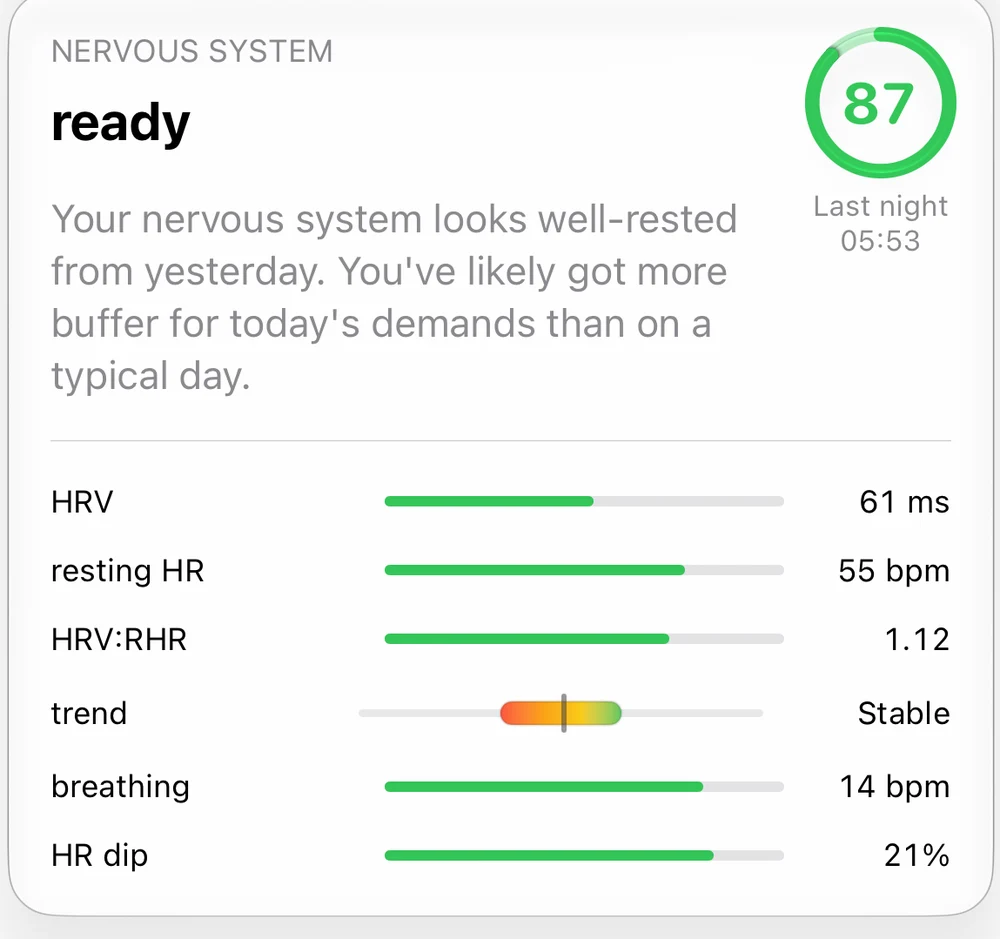

Acute stress is the spike you feel right now: the deadline, the argument, the standing too long at the sink. Your nervous system fires, HRV drops, heart rate climbs. A stress monitor reads that.
Resilience is what happens next - how quickly HRV returns to your baseline, how steadily your gait holds up, how cleanly sleep restores you. Two people can hit the same stress peak and only one of them wakes up restored.
The resilience score reads the rebound, not the peak. It's the difference between asking am I stressed and asking am I depleted. Those are not the same question, and the second one is the one your body has been answering all along.
Every read is graded against your own rolling 14-to-30-day history. Your "good" doesn't have to match a generic norm - it has to match you, last week, on a steady stretch. We use percentile ranks against your personal record so the same recovery time that's mediocre for an athlete can read as excellent for you, and vice versa.
This is the entire reason the score is usable for people whose numbers don't fit the textbook. The textbook was written about other bodies.
Free for core features. No card needed.
A resilience score should show what it reads and where the signal lives. Body Insights turns HRV recovery and supporting signals into one plain morning sentence.
The signals below feed a single composite read. The largest contribution comes from HRV recovery efficiency. The others reinforce or contradict it, in that order of weight.
How quickly heart rate variability returns to your personal baseline after a stress spike. The single most predictive input. Read against your own 14-30 day history, not a population norm.
How well your step count, stand frequency, and gait stability hold up during stressful windows. A body with capacity keeps moving. A depleted body sits down.
Sleep efficiency overnight, normalized to your baseline. Not raw hours - how much of the night actually restored you.
How reliably your body rebounds across many small events, not just the dramatic ones. Consistency is the quiet ingredient most scores miss.
We show two sub-reads. Cognitive resilience covers focus and decision load. It draws on HRV recovery and gait steadiness. Physical resilience draws on walking steadiness and stand frequency. Some days one is fine and the other is gone.
The output isn't a number you have to interpret. It's a sentence: "Today has less in it than yesterday. The slow HRV rebound is the story."
The score resolves into one of four plain-language states: resilient, normal, vulnerable, and high risk. They describe capacity, not character. A vulnerable day isn't a failed day - it's a day that earns rest as the actual prescription.
The recommendation that comes with each state matches it. Resilient mornings get green-light language. Vulnerable mornings get permission. High-risk mornings get a short list of stressors worth deferring. We don't tell you to push through. Pacing is the entire point.
This is what "rest is part of the plan, not a failure of it" looks like as a daily output.
These terms get used interchangeably by every wearable on the market. They're not the same thing. Here's how Body Insights uses them and how the major rings and straps differ.
| Whoop / Oura | Apple Vitals | Body Insights | |
|---|---|---|---|
| Reads HRV recovery, not just HRV value | Partial | No | Yes |
| Personalized baseline (your own history) | Partial | Yes | Yes |
| Cognitive vs. physical split | No | No | Yes |
| Tuned for chronic illness / variable energy | No | No | Yes |
| Plain-language morning sentence | Partial | No | Yes |
| Subscription | $6-30 / month | None | Free for core |
| Extra hardware | Ring or strap | None | None |
Whoop and Oura built thoughtful products for athletes optimizing training load. Apple's Vitals view is a quiet, well-designed snapshot. Body Insights is the read for the person whose recovery doesn't follow a training plan and whose baseline doesn't match the population.
A daily read of capacity - what your body can still spend - anchored largely in HRV recovery against your own baseline. Stress measures load. Resilience measures reserves.
Stress reads what's happening now. Resilience reads how well you rebound afterward, across days. The two together tell you what today can hold.
How quickly heart rate variability returns to your personal baseline after a spike. We read it against your own 14-30 day history, not a generic norm.
Yes. The whole point of a personalized baseline is that the absolute value doesn't gate the read. What matters is movement relative to your own pattern.
The Watch tracks the underlying signals - HRV, resting heart rate, walking steadiness, stand hours. Body Insights reads them from Apple Health and translates. The watch tracks. We translate.
Free for core resilience and recovery reads. A premium tier adds deeper analytics and the metabolic layer. No card needed to start.
On-device. No account. No subscription required. No data sold. Ever.

Free for core resilience and recovery insights. Premium adds deeper analytics.