Outdoor Walk
A regular brisk walk with the watch on your wrist is enough. The most accessible of the three.

Fitness Age · HUNT study backed
Turn your Apple Watch VO2 max into one age and track how it changes over six months.
Your number, now
Enter the Cardio Fitness value from Apple Health. The calculator turns your Apple Watch VO2 max into the same Fitness Age result used by Body Insights.
A lower Fitness Age means your VO2 max matches the reference value for a younger adult. See how Body Insights calculates Fitness Age.
Fitness age isn't a verdict. It's a translation. Your Apple Watch records how your heart and lungs handle effort during walks, runs, and hikes - and from that it estimates a VO2max value. A fitness age calculator takes that VO2max and asks a different question: how does this compare to people across the full adult age range?
That comparison is the number you see. It's not about how you look or how fast you move. It's about how efficiently oxygen reaches your working muscles - and unlike your birthday, it responds to what you do this month.
If the reading surprised you, that's worth knowing about. It's not the end of a story. Often it's the start of one.

A single reading is a snapshot. The line across several months tells the story. On this chart, it moves gently down. A lower fitness age means a younger cardiovascular system.
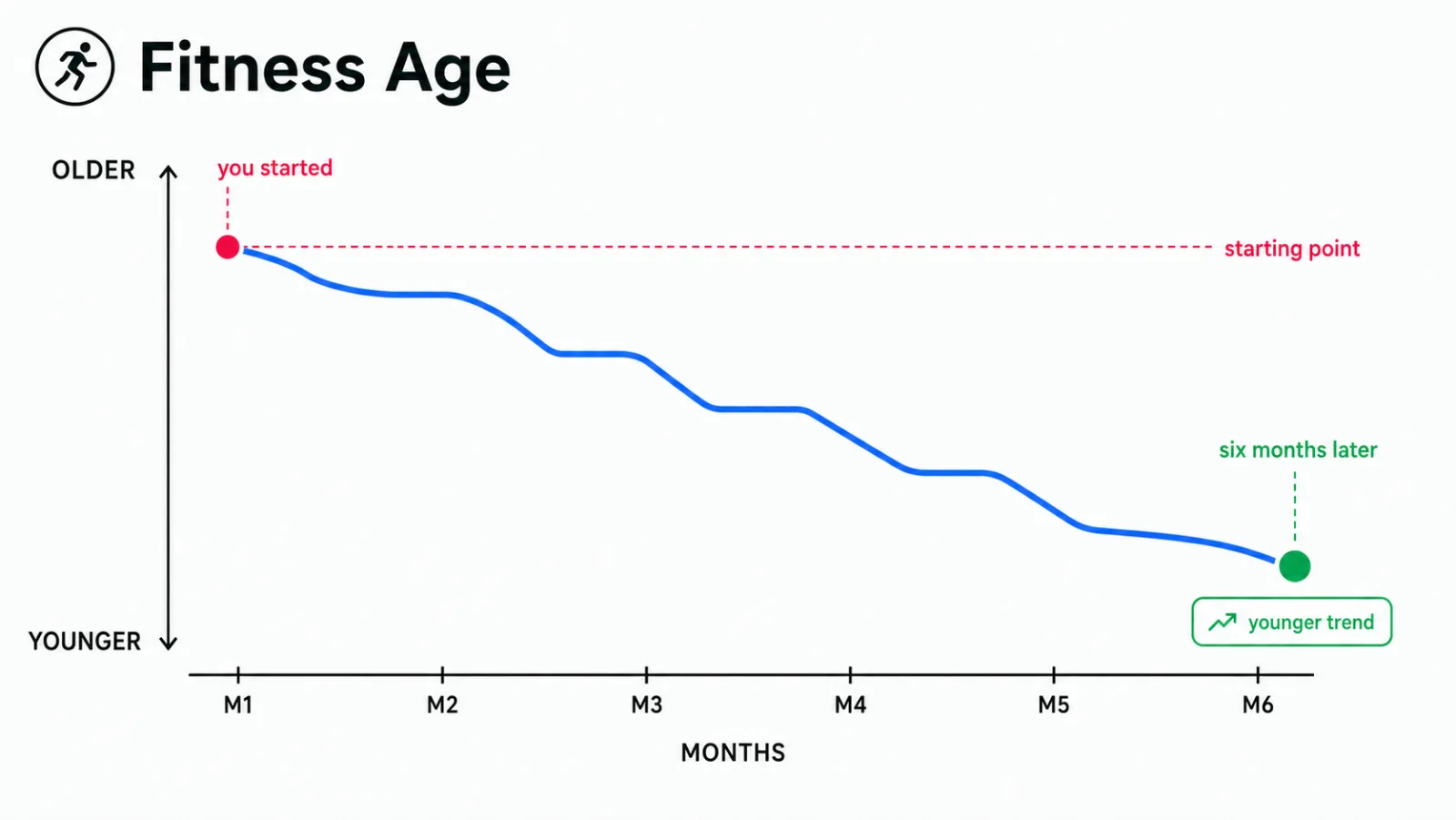
Fitness age moves slowly. The shape over months is more honest than any single reading.
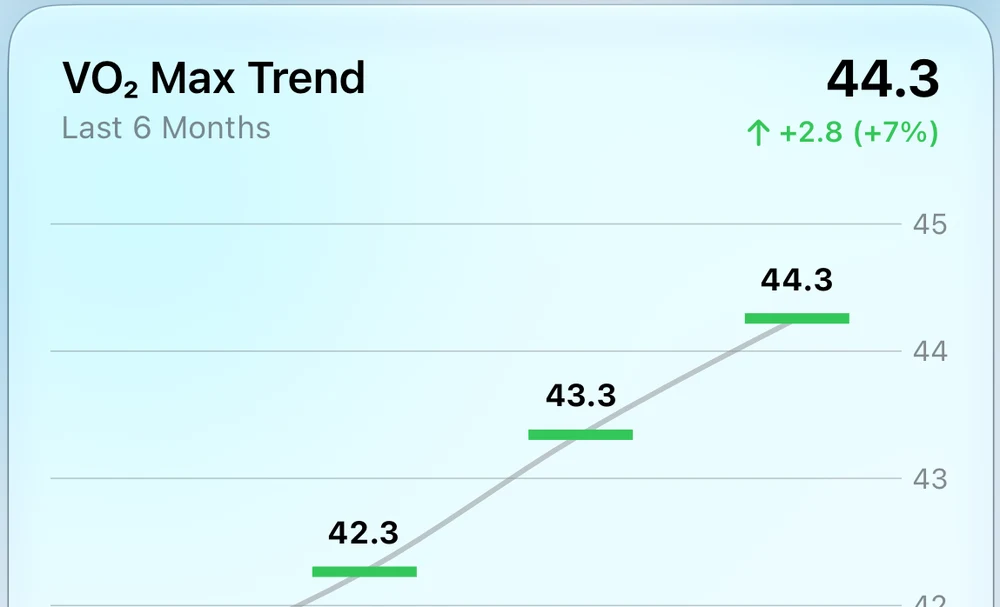
Fitness age estimates how your cardiovascular fitness compares to the average across age groups. VO2max is the underlying metric - the maximum amount of oxygen your body can use during sustained effort. Higher VO2max maps to a younger fitness age. Lower maps to older.
It's not a wellness score. It doesn't reflect how you slept, how your joints feel, or what your nervous system did overnight. It specifically reads aerobic capacity. For an audience whose energy varies day to day, that distinction matters: your fitness age can be steady or improving even on weeks that feel hard.
Research links higher VO2max to better long-term heart and metabolic health. It also links it to better recovery from illness. That's the reason the metric is worth reading. Not as a judgement - as a signal.
Everything below is what an honest fitness age calculator should tell you. If you're shopping comparisons, you're in the right place.
The Body Insights fitness age scale traces back to the Nord-Trøndelag Health Study (HUNT). This Norwegian public-health dataset included more than 3,000 healthy adults aged 19 to 89. Researchers measured their VO2max directly. The study was published in the Scandinavian Journal of Medicine & Science in Sports in 2013. It remains a widely cited sample for cardiovascular fitness benchmarks.
The HUNT team - and the Cardiac Exercise Research Group (CERG) at NTNU that grew out of it - showed that a person's VO2max maps cleanly to the average value for a given age. That map is what lets a calculator say "your aerobic capacity sits at the level of a typical 45-year-old" rather than just printing a number with no context.
We cite the study by name because the credibility of a fitness age calculator depends entirely on what it's calibrated against. If a calculator doesn't tell you, that's worth asking about.

Apple Watch estimates VO2max from heart rate and motion during three specific workout types: Outdoor Walk, Outdoor Run, and Hiking. It does not estimate VO2max from indoor workouts, strength sessions, or cycling. The estimate is personalised to your age, weight, height, and any medications that affect heart rate.
This is the line that matters: Outdoor Walk counts. You don't need to run. You don't need to train. A regular brisk outdoor walk with the watch on your wrist is enough for Apple to produce a VO2max value and update it over time. For readers who are not runners - and especially for anyone whose body can't run - this is the part most calculators forget to say out loud.
Body Insights reads the VO2max value from Apple Health and maps it to the HUNT study fitness age scale. We don't measure anything ourselves. Your watch does the work. We translate.
A regular brisk walk with the watch on your wrist is enough. The most accessible of the three.
Any outdoor running workout with the watch. Pace doesn't need to be fast.
The Hiking workout type. Hills help; flat trails still count.
Reads the value Apple Watch writes to Apple Health. We don't re-estimate.
Translates your VO2max into a fitness age using the Nord-Trøndelag (HUNT) scale.
The trajectory of your fitness age across months - lower-is-better, in plain view.
VO2max combines resting heart rate, recovery efficiency, and training consistency in one signal. Adding separate measures on top would create complexity without adding clarity. The CERG group's work makes a direct case. One well-measured VO2max value can tell you more than a composite score. That type of score can contain many variables that you must weigh yourself.
That's why the read here is narrow on purpose. Body Insights doesn't blend your steps, your sleep, and your HRV into the fitness age number. Those belong in other reads. This one stays clean.

VO2max responds to aerobic movement. The research suggests it can move faster than most people expect, even at modest effort. For anyone managing variable energy, the rule isn't push harder - it's show up more often, at the pace your body can hold.
Regular walks at a comfortable-but-purposeful pace build the aerobic base. Three short walks a week, repeated for two months, will do more than one hard session.
Brief stretches of slightly harder effort - a hill, a few minutes faster - followed by easier walking. Only on days that have it in them.
Swimming, cycling, walking at a sustained comfortable pace. The watch doesn't read all of these for VO2max, but they still build the underlying capacity.
Aerobic adaptation happens during recovery, not during effort. Rest days are part of the plan, not a failure of it.
There's no version of this where you "boost" your VO2max. The number moves when the system gets stronger, and the system gets stronger by being used at a sustainable level over time.
Where your number sits relative to age-group averages, for non-athletes.
| Age group | Women (ml/kg/min) | Men (ml/kg/min) |
|---|---|---|
| 20-29 | 33-42 | 43-52 |
| 30-39 | 31-40 | 41-50 |
| 40-49 | 29-38 | 39-48 |
| 50-59 | 27-36 | 37-46 |
| 60-69 | 25-34 | 35-44 |
Sources: Inscyd (2023), Fitnescity (2025), HUNT study (2013). A value above the average for your age group means a younger fitness age. Research also links it to better long-term heart health. Values below the average are common in midlife, after illness, and during perimenopause. The trend over several months matters far more than one reading.
Lower VO2max readings are common with ME/CFS, Long COVID, chronic Lyme, and chronic EBV. They are also common with fibromyalgia, POTS, and post-viral recovery. This is a known pattern in the literature, not a personal failure. Reduced aerobic capacity is part of the physiology of these conditions.
What this means in practice: the absolute number tells you less than the trajectory. A VO2max that holds steady over six months is doing something. A VO2max that rises a single point - even if it's still below the age-average - is meaningful work. Body Insights shows the six-month trend alongside the number for exactly this reason.
The framing is gentle on purpose. Improvement here is real, but it doesn't follow a training plan. It follows what your body can hold.

You may have already seen a number elsewhere. Here is how the options differ.
| Apple Health | Garmin Fitness Age | Polar Fitness Test | Body Insights | |
|---|---|---|---|---|
| Shows VO2max | Yes | Yes | Yes | Yes |
| Translates to fitness age | No | Yes | Yes | Yes |
| HUNT study scale | No | Yes (CERG) | Partial | Yes |
| Reads Apple Watch directly | Yes | No (Garmin only) | No (Polar only) | Yes |
| Six-month trend chart | Limited | Yes | Yes | Yes |
| Built for variable baselines | No | No | No | Yes |
| Subscription | None | None | None | Free app |
Apple Health shows VO2max but doesn't translate it into a fitness age. Apple’s new Health Age, in the Health app’s Longevity tab, is a different number: it blends VO2 max, resting heart rate, sleep and HRV into one age (see how Health Age differs). Garmin's Fitness Age (also built on the CERG / HUNT work) requires a Garmin device. Polar's Fitness Test requires a Polar device. Body Insights reads what your Apple Watch already records - no second wearable, no migration.
Your cardiovascular age - an estimate of how old your heart and lungs actually are, based on your VO2max. A fitness age calculator compares your VO2max to age-group averages from the HUNT study and returns the age at which your value sits at the middle of the curve.
From VO2max. Your Apple Watch estimates VO2max during Outdoor Walk, Outdoor Run, and Hiking. Body Insights reads that value from Apple Health and maps it to the HUNT study fitness age scale.
Yes. Outdoor Walk, Outdoor Run, and Hiking are the three workout types Apple Watch uses to estimate VO2max. You do not need to run. A regular brisk outdoor walk with the watch on is enough.
Regular aerobic movement at a pace your body can sustain. Consistency over intensity. Short walks repeated through the week tend to move the number more than occasional hard sessions.
For women in their 40s, 29-38 ml/kg/min is the typical non-athlete range; for men, 39-48. Above is younger fitness age; below is common and responsive to consistent movement.
Good enough for trend reading; less precise as a single point-in-time number compared to a lab test. For watching whether your fitness age is moving in the right direction across months, the signal is strong.
The fitness age read needs Apple Watch VO2max data. If you have a Series 3 or later and have done at least a few Outdoor Walk, Run, or Hike workouts, your watch should have a value.
Your VO2max, your workout history, your fitness age trend. None of it leaves the phone unless you explicitly export it.

Your Apple Watch data, translated into one number.
