Moderate
You can hold a conversation but not sing. Brisk walk, easy bike ride, recreational swim, light dancing, a gentle yoga flow.
How Much Fitness · WHO + CDC + HHS guideline
150 minutes of moderate movement a week - per WHO, CDC, and HHS. That's about 22 minutes a day. Less than most plans suggest. And since 2018, short sessions count.
iPhone + Apple Watch. Free for core features. Data stays on your device.
Research links 150 minutes of moderate movement per week to real health gains. The alternative is 75 minutes of vigorous movement. Both targets support heart health, metabolic function, mood, and sleep. The WHO 2020 guidelines, the US HHS 2018 guidelines, and the CDC 2023 update all land on the same number.
That's about 22 minutes a day, if you spread it evenly. Or three 50-minute walks. Or eight short bursts across the week. The shape is yours. The total is what the research measured.
Most weekly plans you've seen - apps, gym programs, magazines - quietly inflate this. The actual evidence base is gentler than the marketing.
Built for people returning to movement or managing variable energy. That includes ME/CFS pacing, perimenopause, and recovery after illness. It is also for anyone tired of exercise advice written for athletes.
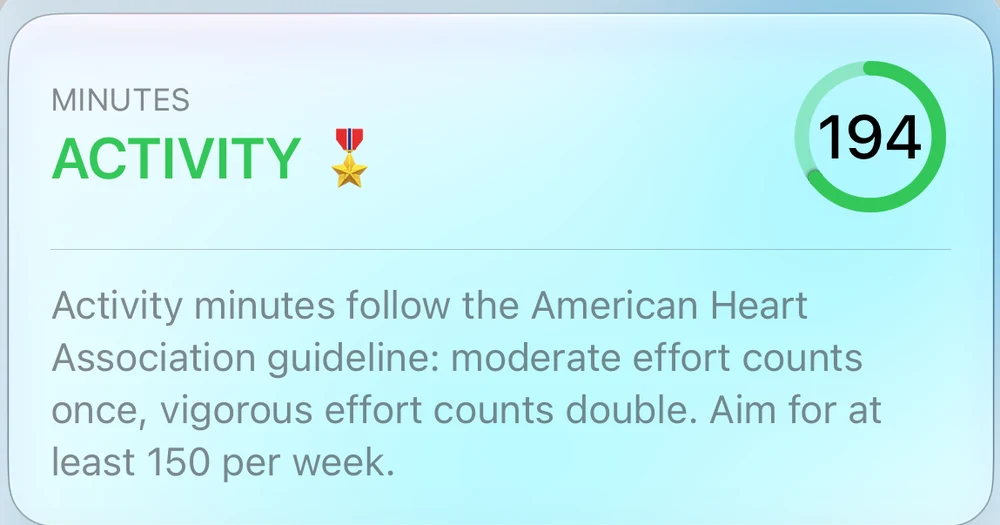

For decades, the official guidance said exercise only counted if it lasted at least ten minutes. The HHS 2nd edition (2018) removed that rule. Short sessions now count toward your weekly total. That can be a five-minute walk to the mailbox or three minutes up a hill. A quick stretch flow between meetings counts too. All of it adds up.
This is the most important update for anyone whose energy isn't reliable. The old ten-minute floor excluded many people. It left out people in a flare, people recovering from a virus, and anyone who can manage two minutes but not ten. The science moved. The plans haven't caught up.
We mention this near the top on purpose. If you've been told that "real" exercise has to be a continuous block, that wasn't true even before 2018. It is officially not true now.
Brisk walking to 150 minutes per week meets the guideline in its entirety - no caveats, no "but ideally you'd add..." The CDC names walking explicitly as a moderate-intensity activity that counts.
A brisk pace is roughly a 15-to-20-minute mile. If you can talk but not sing, you're there. Adding hills, a faster stretch in the middle, or a small backpack are natural next steps when you're ready - they're not required for the guideline to apply.
If walking is what your body can do today, walking is the answer. It's not a starter version of real exercise. It is the exercise the major guidelines were measuring.

Free for core features. No card needed.
Everything below is what an honest read of the guideline should tell you. If you're shopping comparisons or sources, you're in the right place.
You don't need a heart rate strap to know which zone you're in. The talk test works.
You can hold a conversation but not sing. Brisk walk, easy bike ride, recreational swim, light dancing, a gentle yoga flow.
You can speak short phrases between breaths. Jogging, faster cycling, harder swim, interval effort.
The 150-and-75 numbers are designed to be equivalent. Vigorous earns the same outcomes in half the time - but costs more recovery.
Mood lift, lower anxiety, easier sleep that night. The earliest benefits arrive faster than people expect.
Steadier energy, better sleep quality, lower blood pressure, improved cholesterol, better insulin sensitivity.
Reduced risk of heart disease, stroke, type 2 diabetes, and several cancers. The long-term gains arrive on top of the same-day ones.
Your Apple Watch is the tracker. Body Insights reads its data from Apple Health. It compares your week with the WHO, CDC, and HHS guideline. The morning summary tells you where you are in plain language. Not a leaderboard. A reading.
How your moderate and vigorous minutes are adding up against the 150-and-75 target.
Five-minute walks counted in, not filtered out. Honors the 2018 HHS update.
The 2×-per-week resistance recommendation tracked separately from cardio minutes.
Your last four weeks against the four before, so you can see direction - not just today.
One sentence in the morning: "You're at 90 minutes this week. A short walk before dinner brings you within ten of the guideline."
We measure against your trajectory, not an athlete's. The guideline is the destination, not the starting line.
If you're managing ME/CFS, Long COVID, fibromyalgia, POTS, or post-viral recovery, the 150-minute number is the destination - not the starting line. The starting line is whatever your body can do this week without provoking a crash.
The pacing principle: start below your suspected limit, hold there for a stretch, then expand only when the floor feels steady. Two minutes of slow walking, twice a day, is a real starting point. Five minutes the week after is real progress. Rest days are part of the plan, not a failure of it - the research shows the largest gains come from moving from nothing to a little, not from a little to a lot.
Apple Watch tracks your active minutes. Body Insights shows the pattern across the week. You see what you did, how your body responded, where to ease, and where there is room.

Three major bodies. One number. The differences are in the framing, not the threshold.
| CDC 2023 | HHS 2018 | WHO 2020 | |
|---|---|---|---|
| Moderate cardio / week | 150 min | 150-300 min | 150-300 min |
| Vigorous cardio / week | 75 min | 75-150 min | 75-150 min |
| Strength training | 2+ days | 2+ days | 2+ days |
| Walking counts | Yes, named | Yes | Yes |
| Minimum bout length | None | None (removed 2018) | None |
| Talk test for intensity | Yes | Yes | Yes |
The CDC, HHS, and WHO are independent bodies that reviewed the evidence separately and arrived at the same threshold. When three groups land on one number, the number is the number.
150 minutes of moderate movement, or 75 minutes of vigorous, or any combination that totals the equivalent. Spread it however your week allows.
Yes - fully. Brisk walking to 150 minutes per week meets the guideline. The CDC names walking explicitly as a moderate-intensity activity.
Short sessions count, officially, since the 2018 HHS update. A five-minute walk, a ten-minute bike ride, three minutes up a hill - all of it stacks. There is no minimum bout length.
Any gentle movement still contributes, and rest is part of the plan, not a failure of it. The largest health gains came from moving from sedentary to lightly active.
The guidelines recommend muscle-strengthening activity on 2 or more days per week. Body-weight work, resistance bands, light dumbbells - all count.
Where you are. Ten or fifteen minutes of gentle walking is a real starting point. The gains from sedentary-to-light are larger than light-to-moderate.
Your activity minutes, your workout history, your weekly patterns. None of it leaves the phone unless you explicitly export it.
Free for core movement insights. Premium adds deeper trajectory analytics.