Build
Fitness rising steadily, form controlled. The productive zone - the weeks when work actually accumulates as adaptation.
Training Load · CTL · ATL · TSB on Apple Watch
You used to read CTL, ATL, and TSB to know what your body could hold. Then a chronic illness rewrote the rules. Body Insights reads your Apple Watch and rebuilds the picture - tuned for a body whose baselines move.

There was a year - maybe more than one - when you knew exactly what your legs could do on a Saturday. You read your form number on Monday. You planned the week around it.
Then something changed. A long illness. A diagnosis. A perimenopausal year that broke every recovery rule you'd ever trusted. The training-load tools you used were built for healthy athletes ramping toward a race. They didn't know what to do with a body that needs rest as the work, some weeks.
Body Insights reads your Apple Watch the way your old coach used to. Fitness. Fatigue. Form. The Banister Impulse Response triad was published in 1991. It remains a clear way to picture how training builds. Body Insights places it beside your sleep and HRV. If you wear a CGM, it also shows your overnight glucose.
Fitness rises slowly. Fatigue spikes and recovers. Form is the gap between them - and it's the line that tells you when to push and when to rest.
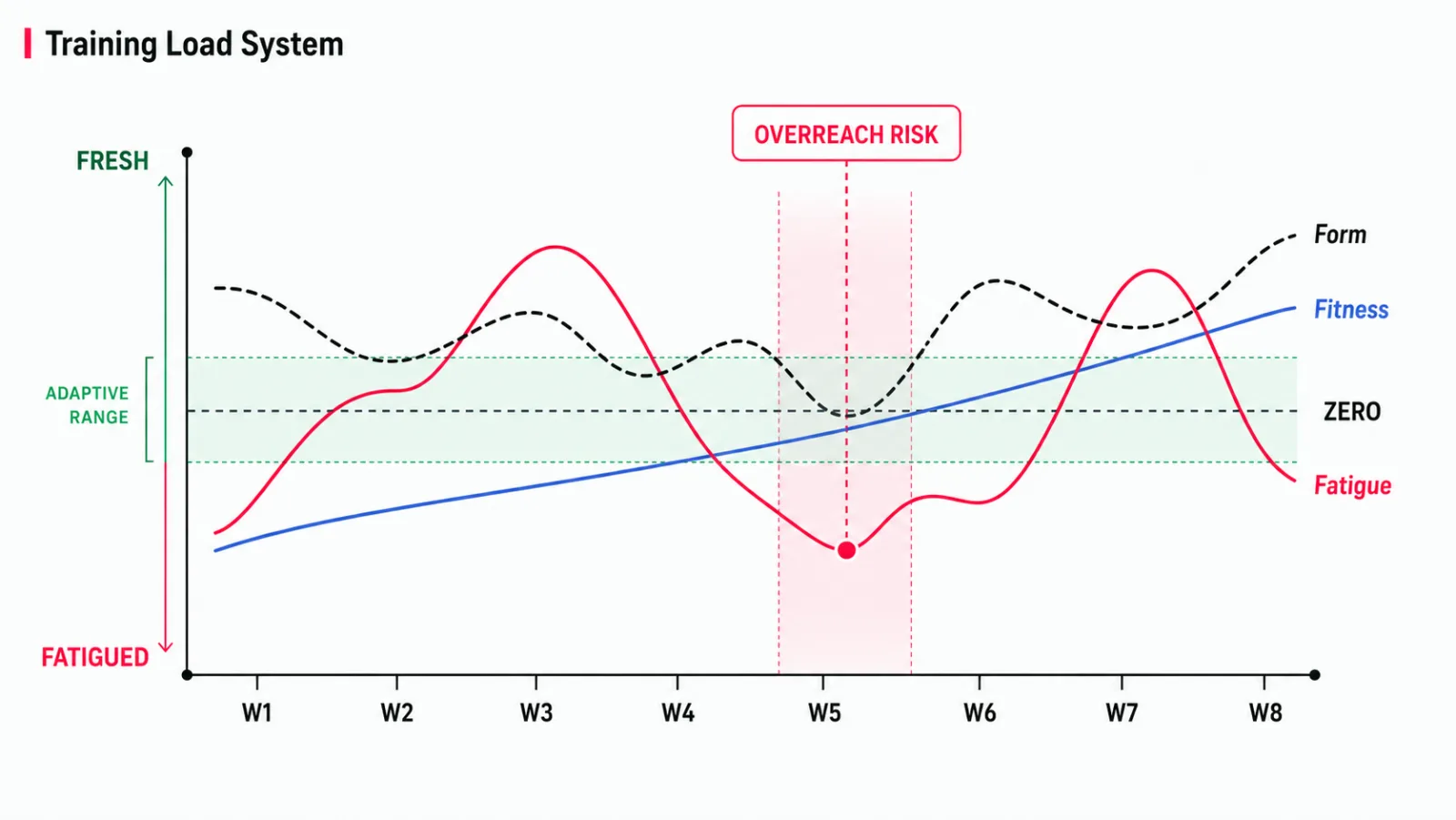
Read the three lines together - fitness building, fatigue spiking, form drifting below zero - and the week your body asked for a break stops being a guess.

Classic training stress reads heart rate and duration. That's a clean number when your physiology is steady. It can mislead you during recovery from illness. Perimenopause can also shift your glucose response. A poor night of sleep can change the body you train with today.
Metabolic-mTSS adds glucose stability to the stress cost of each session. It uses overnight and workout glucose data. A run on a calm metabolic day registers as the work it was. The same run after a poor night, with glucose drifting all afternoon, registers as more - because it cost more. The CTL, ATL, and TSB built on top of that score reflect the body you actually trained with, not the body the textbook assumed.
If you don't wear a CGM, the metabolic layer drops out and standard mTSS carries the read.
Free for core features. No card needed.
The framework will look familiar if you have used training stress charts. It uses the Banister Impulse Response Model. Coaches have used that model since 1991.
Form and fitness don't sit still - they cycle through phases. Body Insights names the phase you're in so you don't have to interpret the chart yourself.
Fitness rising steadily, form controlled. The productive zone - the weeks when work actually accumulates as adaptation.
Load coming down, form fresh, base intact. The phase classic coaching calls a taper - the body sharpest just as the work eases.
Fatigue running well above fitness. A short stretch of this is part of training. A long stretch is the early room of overtraining.
Deep negative form, ramp rate rising fast. The label exists so you have something to point at when your body says enough.
Steady ramp, neutral form. Not building, not losing - the holding pattern. Often the right one during a flare or a busy season.
Load tapering away, fitness drifting down. Named explicitly so a long rest period reads as recovery, not as failure.
Reads workout, heart rate, and (optionally) glucose data from Apple Health - the same data your Apple Watch and your CGM already write there.
It uses duration, heart rate, and intensity zones. These inputs become a stress score for each activity in Apple Health.
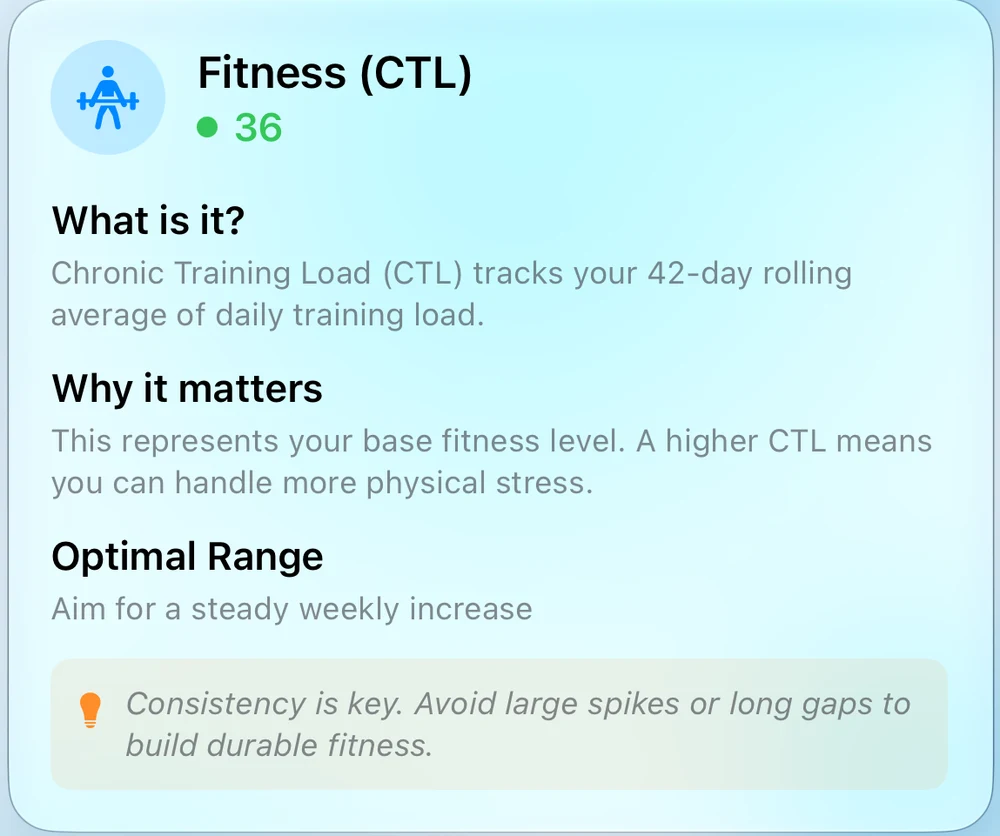
Your chronic training load - the work your body has gotten used to, weighted toward steady accumulation rather than recent spikes.
Your acute training load - the work still in your legs, weighted toward the most recent sessions.
Training stress balance - the gap between fitness and fatigue. Positive is fresh, negative is fatigued, drifting back to zero is the rhythm of training.
How fast fitness is changing week over week. The signal that separates productive build from the climb into overreaching.
If you wear a CGM. Adjusts the stress cost of a workout for glucose stability - the layer no other training-load tool reads.
Eric Banister and colleagues published the Impulse Response Model in 1991. It treats performance as the difference between two responses. Fitness builds slowly after training, while fatigue changes faster. Later CTL, ATL, and TSB tools use this framework.
It's an honest model. The model does not claim to know everything about your body. It says training builds along a slow curve on average. Fatigue fades faster. That insight is what makes form readable.
Body Insights calculates the same triad from workouts recorded by your Apple Watch. It displays the result beside your sleep and metabolic data. That context affects how much training load your body can absorb.

You may have used one of these before. Here is how the options differ.
| Strava F&F | TrainingPeaks | Whoop | Body Insights | |
|---|---|---|---|---|
| CTL / ATL / TSB | Yes | Yes | Strain only | Yes |
| Reads all Apple Health workouts | Partial | Partial | Strap-only | Yes |
| Overnight glucose layer | No | No | No | Yes |
| Tuned for variable baselines | No | No | No | Yes |
| Subscription | $12 / month | $20 / month | $30 / month | Free for core |
| Extra hardware | None | None | Strap | None |
Strava, TrainingPeaks, and Whoop are real products built by careful people. They were built for athletes whose physiology cooperates. If yours doesn't always - chronic illness, hormonal shifts, post-illness recovery - this was built for you.
Apple Watch records workouts and heart rate. Body Insights reads those workouts and builds the CTL, ATL, and TSB triad. Strava and TrainingPeaks made this chart familiar. Here, it sits beside the rest of your health data.
CTL is fitness - what your body has sustained. ATL is fatigue - what's still in your legs. TSB is form - the gap between them. Positive is fresh, negative is fatigued, the rhythm matters more than any single day.
No. We built it for ex-athletes managing chronic illness who miss having form numbers to plan a week. The math is the Banister framework; the lens is a body whose baselines move.
Strava reads cycling and running. Body Insights reads any workout captured by Apple Health. That includes strength, walking, yoga, and swimming. It also adds overnight glucose stability to the stress cost. No subscription. No platform lock-in.
No. Without a CGM you get standard CTL, ATL, TSB read off your Apple Watch workouts. With one, metabolic-mTSS adjusts the cost of each session for glucose stability.
Free for core training-load features. A premium tier unlocks the metabolic-mTSS layer and deeper phase analytics. No card required to start.
On-device. No account. No subscription required. No data sold. Ever.

Free for core training-load features. Premium adds metabolic-mTSS.