Stage-aligned glucose
Every glucose sample is tagged with the sleep stage you were in at that moment. Deep, core, REM, awake - each gets its own baseline.
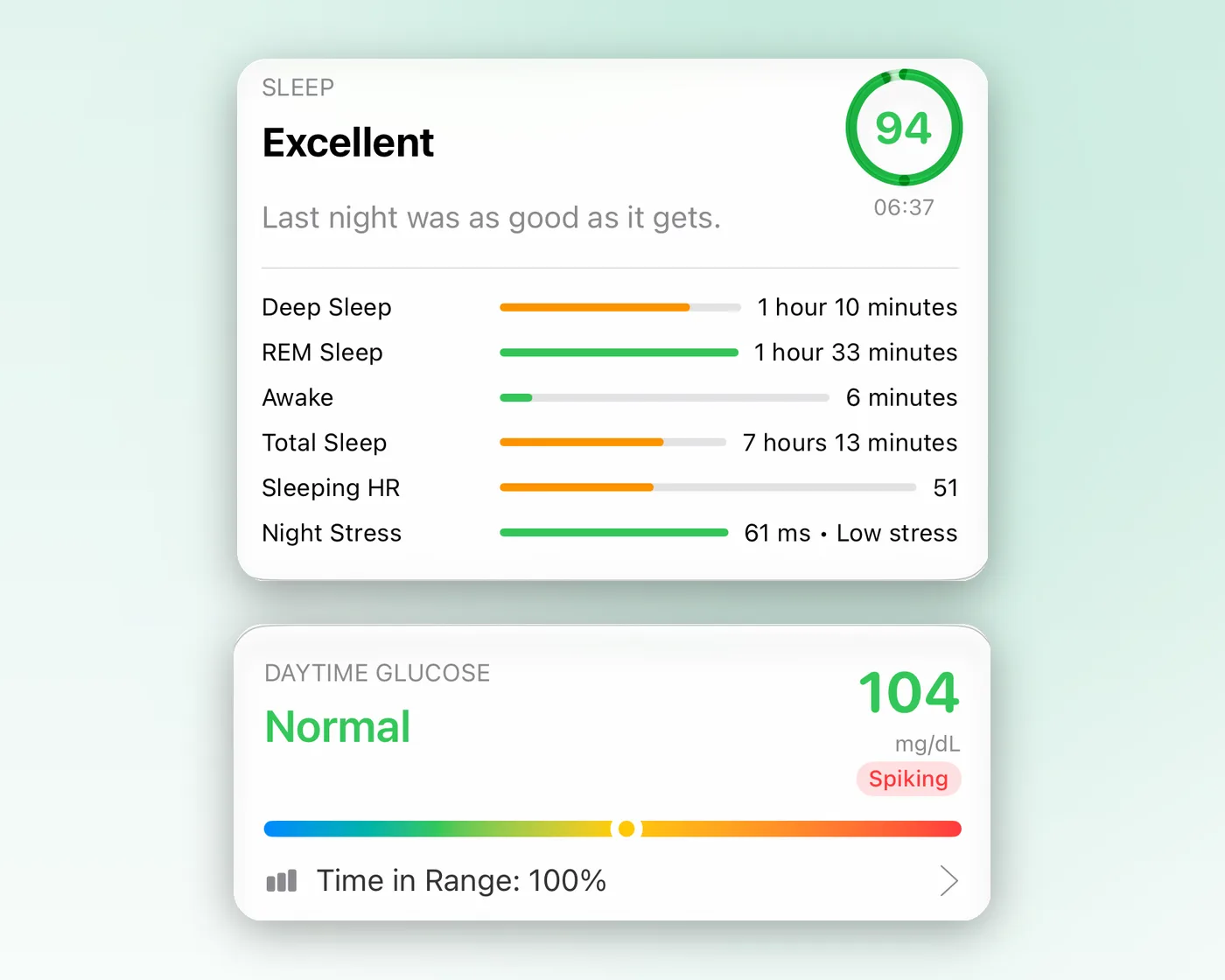
Metabolic Sleep Analysis · CGM + sleep stages
If you wear a CGM, your overnight glucose curve is a second story the morning never tells. Body Insights reads it against your sleep stages - so the dawn phenomenon, a deep-sleep dip, or a REM spike actually has a name when you wake up.
You ate dinner at six. You went to bed at ten. You slept through. And still, the first hour of the day feels foggy, the coffee doesn't catch, and your mood is heavier than it should be for a Tuesday.
If you wear a continuous glucose monitor, there's a layer most sleep apps can't see. Your blood sugar doesn't pause when you sleep. It rises with REM, settles with deep sleep, and climbs again before you wake. The dawn phenomenon is a well-known pattern. Cortisol drives glucose up in the last few hours before waking, often with no food in your system.
Body Insights reads that rise against your actual sleep stages, not just the clock. The result is a morning sentence that connects the layers - "Your glucose climbed during the final REM cycle, then again at 5am. That's a dawn pattern, and it tracks with the lighter sleep you had after 4." That's metabolic sleep analysis.
Stages along the bottom. Glucose along the top. Patterns live in the relationship.
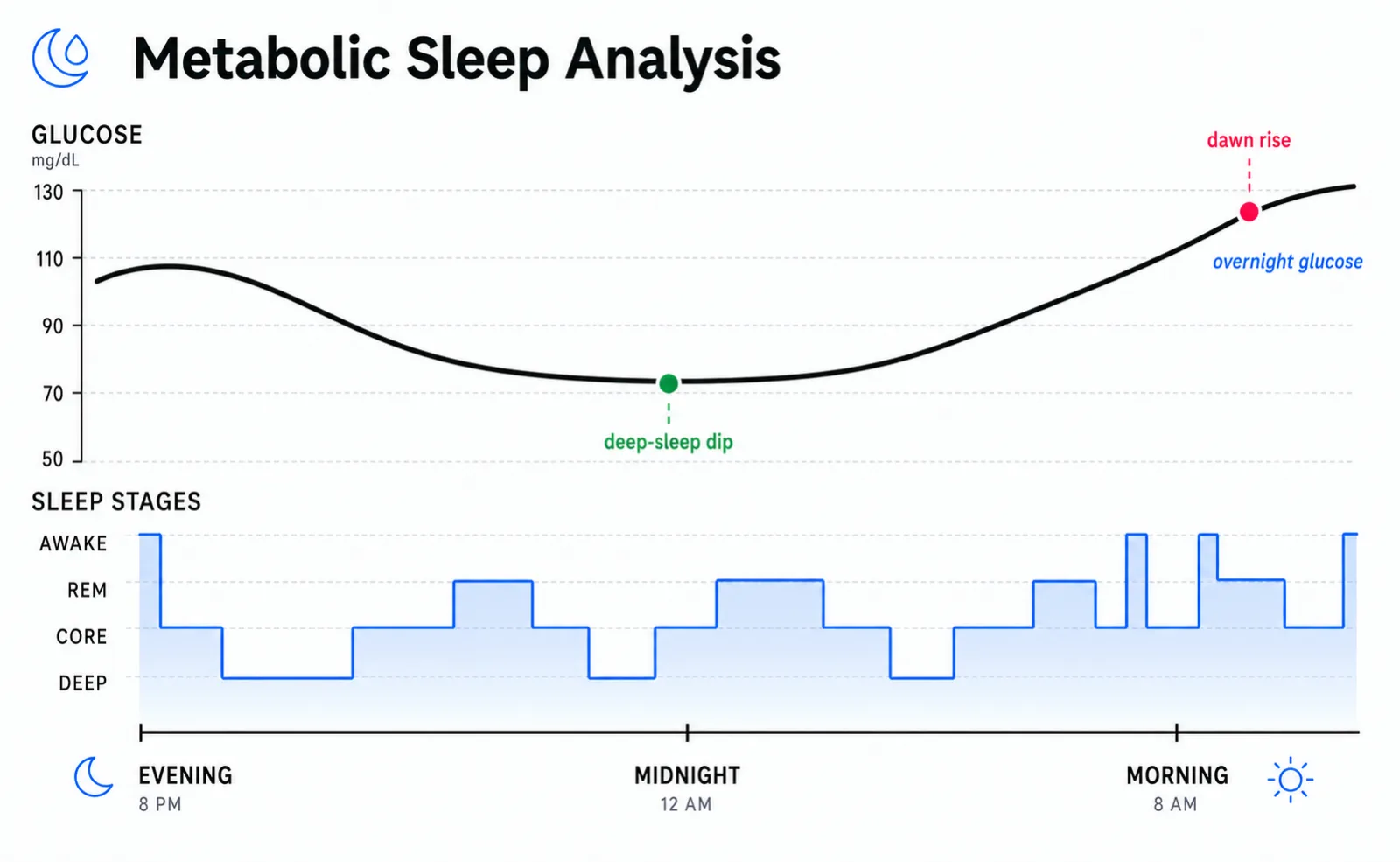
Read top and bottom together. The glucose dip happens while you're in deep sleep; the dawn rise begins as the night gets lighter. The relationship is the insight.
The dawn phenomenon. In the last hours before waking, cortisol surges and the liver releases glucose to prepare your body for the day. For some people the rise is gentle. For others it's the reason fasting glucose looks worse than dinner-time glucose did. Reading it next to your sleep stages tells you whether it tracked your final REM cycle or kicked in later, after a micro-arousal.
The deep-sleep dip. Glucose tends to fall during deep sleep - growth hormone is doing repair work and demand is low. A modest dip is healthy. A sustained low is the body running out of overnight fuel, often the signature of a hard evening workout, alcohol, or a dinner that came too early.
The late-night drop. Sometimes the curve crashes around 2 or 3am, then rebounds sharply. That's the body's stress response stepping in - adrenaline and glucagon pulling sugar out of the liver because the tank ran dry. You'll often see it on the same nights you wake at 4am and can't fall back to sleep.

Most of Body Insights works with just an iPhone and an Apple Watch. This feature doesn't. Metabolic sleep analysis reads from a continuous glucose monitor - Stelo, Dexcom, Libre, or any CGM that writes to Apple Health. Without one, this overlay simply isn't there.
That's the honest constraint. If you're curious about a CGM, the overnight view can show patterns that fingersticks miss. A fingerstick cannot capture a rising curve across four hours of sleep. Without a CGM, the rest of our sleep analysis still works: stages, efficiency, fragmentation, and the morning sentence.
Free for core sleep features. Premium adds the metabolic overlay.
The dawn phenomenon and its overnight cousins are well-described in metabolic literature. What's new is reading them with stage-by-stage context.
Everything below reads from Apple Health. Your CGM writes glucose there. Your Apple Watch writes stages. We align them.
Every glucose sample is tagged with the sleep stage you were in at that moment. Deep, core, REM, awake - each gets its own baseline.
The pre-wake rise is compared to your overnight nadir, not a population average. Your dawn pattern is your own.
Sustained drops during deep sleep get flagged with likely context - late workout, alcohol, an early dinner that ran out of fuel.
A small REM rise is normal. A large one paired with a prior deep-sleep low is something else - the counter-regulatory response, not just stress.
What counts as a meaningful rise for you is calibrated against your own history. A pattern is a pattern when it stands out from your nights.
You don't get a chart and a shrug. You get one sentence that names the pattern and ties it to something that happened the day before.
A glucose rise at 5am tells you very little on its own. The same rise read against your sleep tells a story. A rise during your last REM cycle fits expected physiology. REM sleep activates the sympathetic nervous system while cortisol is already climbing. A rise during a long awake period has a different context. Your body may have treated the awakening as morning and started the day early.
This is why most overnight glucose charts feel incomplete. A flat CGM trace from a glucose-only app doesn't know whether you were in deep sleep or staring at the ceiling at 3am. Stage-aligned reading puts every value into context - and the context is usually where the actionable insight lives.
The same logic applies to lows. A drop to the low 70s during deep sleep, while growth hormone is peaking, is a different physiological event than the same value during a micro-arousal. Body Insights treats them as separate findings.

The honest comparison if you're already wearing both.
| Apple Sleep app | CGM app (Stelo / Libre) | Body Insights | |
|---|---|---|---|
| Sleep stages | Yes | No | Yes |
| Overnight glucose trace | No | Yes | Yes |
| Glucose aligned to sleep stages | No | No | Yes |
| Dawn phenomenon pattern | No | Partial | Yes |
| Plain-language morning | No | No | Yes |
| Subscription | None | CGM hardware | Free core · premium adds overlay |
CGM apps show you the curve. Sleep apps show you the stages. Neither one reads them together. That gap is the thing this feature exists to close.
An early-morning glucose rise driven by your cortisol awakening response. The liver releases glucose to prepare you for the day - even with no food in your system overnight.
Yes. A continuous monitor catches the gradual rise that fingersticks miss. Body Insights reads it against your stages, so you can see when it began.
Growth hormone peaks and demand falls. A small dip is healthy. A sustained low usually means overnight glycogen ran short - often after a hard workout or alcohol.
A small rise during REM is physiological - the sympathetic nervous system activates. A larger spike points to metabolic stress or late eating. We flag the difference.
Yes, for this specific overlay. Stelo, Dexcom, Libre, or any CGM that writes to Apple Health. Without one, our other sleep features still work.
Core sleep features are free. The metabolic overlay sits in the premium tier - no card needed to start, no auto-billing.
On-device. No account. No subscription required to read your data. No data sold. Ever.

Free for core sleep insights. Premium adds metabolic-sleep fusion.
