Overnight heart rate
The raw signal. We look for the night's consistent low point - the HR nadir - and use it as a proxy for core body temperature minimum.
Circadian Timing · Chronotype from Apple Watch
Your chronotype isn't a personality quiz answer. It's a phase - the timing of your internal clock. Body Insights reads it from your Apple Watch heart-rate data, no questionnaire required.
Two curves. The darker one is the rhythm we read in your data. The lighter one is the population average. The gap between them is your chronotype.
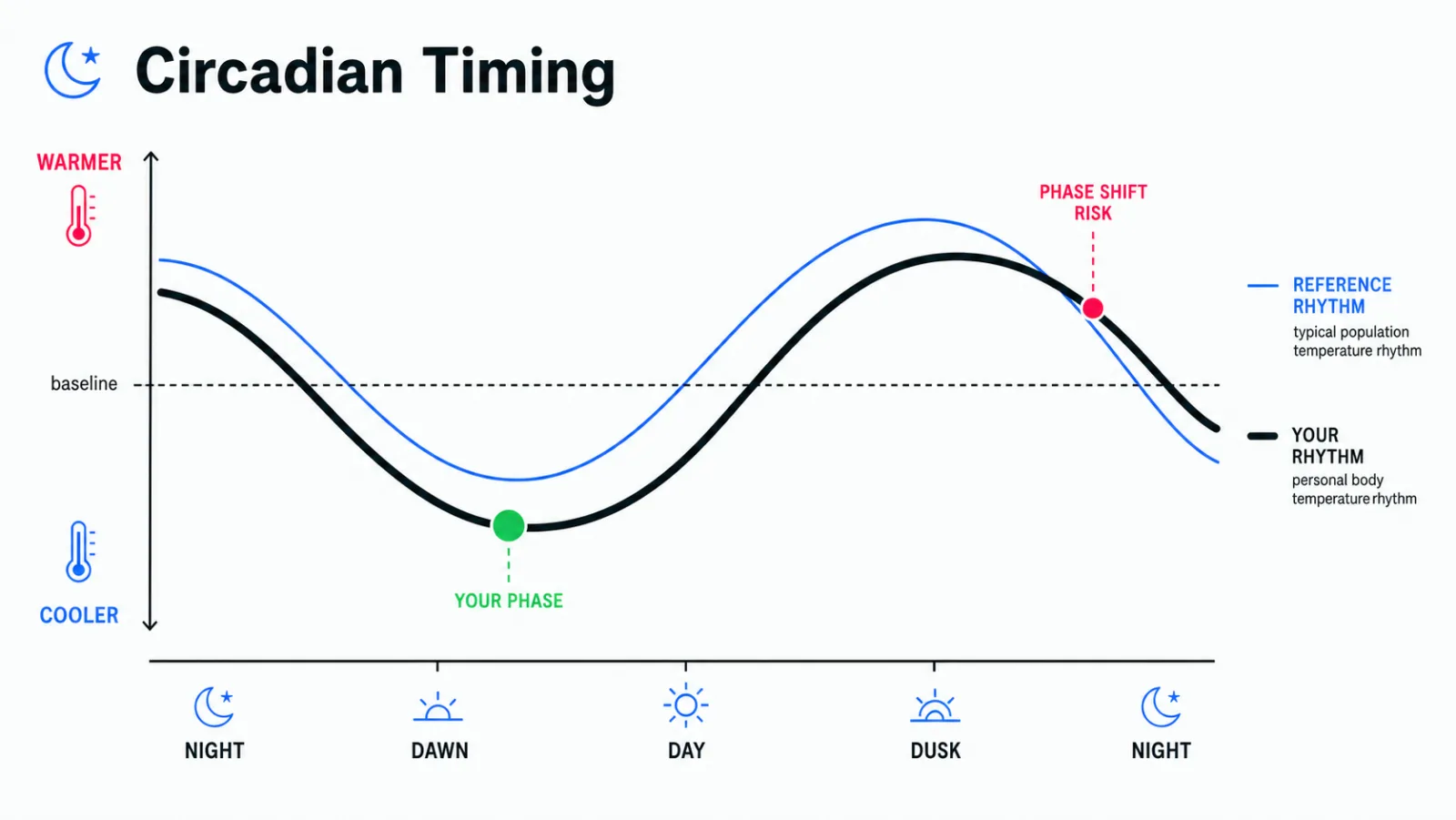
Your phase is your own - earlier than the population, later, or aligned.
You wake at 6 and feel hung over. Your roommate wakes at 6 and bounces into the kitchen. Neither of you is lazy. Neither of you is "more disciplined." You have different chronotypes - different settings on the same biological clock.
For most of the last century, that difference was either ignored or moralized. Chronobiology has spent the last twenty years dismantling that. Till Roenneberg at LMU Munich studied the body's preferred phase. Charles Czeisler's group at Harvard studied phase shifts for decades. Their work found that genes largely set this phase. Pushing too far against it has measurable costs.
Until recently, finding your phase meant a sleep lab or a multi-page questionnaire. Apple Watch changed the inputs. Body Insights reads what it recorded.

Core body temperature has a daily rhythm. It dips overnight and reaches its minimum a few hours before you normally wake. That minimum - CBTmin in the literature - is the classical anchor for your circadian phase.
The trouble is that nobody wears a rectal thermometer to bed. So researchers built proxies. The one that has held up best on the wrist is heart-rate nadir - the lowest point of your overnight HR. It tracks the temperature minimum closely enough to use as a phase anchor when read over multiple nights.
Body Insights reads your overnight HR from Apple Health, finds the consistent nadir across a 7-to-14-day window, and uses it as the anchor for your phase. The pattern is what we trust, not any single night.
One sentence, in the morning, that matches how you actually feel.
"Your phase is running about a half-step later than average - your body's morning starts later than the clock on your nightstand says."
From there, you get plain-language pointers. They show when your alertness may be sharpest and when winding down may feel easier. They also show when light exposure may help or hurt your timing. No specific hours assigned to your phase - your day doesn't fit a textbook, and we won't pretend the number is exact.
Free for core features. No card needed.
If you're comparing tools or want to understand what we're reading, this section is for you.
Reads from Apple Health (HealthKit) - the same data your Apple Watch already writes there overnight. No new sensor, no questionnaire, no account.
The raw signal. We look for the night's consistent low point - the HR nadir - and use it as a proxy for core body temperature minimum.
Single nights are noisy. The pattern of nadirs across a 7-to-14-day window is where your real phase lives.
How crisp the daily rhythm is. A clear, repeating low says a stable internal clock. A drifting, shallow signal says the rhythm is weaker - useful information either way.
Earlier than population, later, or close to aligned. Not a hour, not a number - a direction and a confidence.
Some bodies hold a steady phase week after week. Others, especially with chronic illness, drift. The drift itself is the read.
One sentence in the morning. The chart is there if you want it. The recommendation is in words.
Two threads of primary research underpin the read. First, Till Roenneberg and colleagues at LMU Munich studied chronotype distribution. They found that chronotype follows a normal distribution and is largely genetic. They also found health costs when people push against it. They called this mismatch "social jet lag."
Second, Charles Czeisler's group at Harvard studied phase shifts over many years. Derk-Jan Dijk and colleagues also worked in this field. The research established the minimum core body temperature as an anchor of internal time. It mapped how light shifts that phase. It also showed that overnight autonomic measures can act as proxies for the temperature rhythm.
We cite primary chronobiology from Roenneberg, Czeisler, Dijk, Khalsa, and Zeitzer. We do not use personality-style "morning person / night person" labels. The math is older than the wearable.

Studies often find circadian disruption in post-viral and autoimmune conditions. Studies in ME/CFS describe altered cortisol rhythms and shifted sleep-wake timing. Emerging long COVID literature points to flattened, less robust circadian rhythms in a meaningful subset of patients. The mechanism is not fully settled. Possible causes include inflammation, autonomic dysregulation, and HPA-axis involvement.
Your phase may look later, shallower, or more variable than a healthy-cohort baseline. That finding is consistent with the literature. It does not mean you are doing something wrong. Body Insights reads what your body is actually doing - not what the textbook assumes a body should do.
None of this is diagnosis. It's pattern recognition you can bring to a clinician who knows your story.
You probably tried one of these. Here's where each one fits.
| MCTQ / MEQ questionnaire | Oura / Whoop | Body Insights | |
|---|---|---|---|
| Input type | Self-report survey | Sleep timing only | HR nadir + sleep timing |
| Reads physiological phase | No | Partial | Yes |
| Tracks phase over time | No | Limited | Yes |
| Tuned for variable baselines | No | No | Yes |
| Subscription | Free / academic | $6-30 / month | Free for core |
| Extra hardware | None | Ring or strap | None |
The MCTQ is a research-grade instrument and a fine starting point. Ring and strap apps add useful sleep timing. Body Insights reads physiology directly - and reads it through a lens built for bodies whose baselines move.
Your body's natural preference for when to sleep and when to be alert - set largely by genetics, shifting gradually with age. Roenneberg describes it as the timing of your internal clock relative to the sun.
It records the data we need - overnight heart rate. Body Insights reads the HR nadir as a circadian phase anchor and translates it into chronotype direction.
The overnight HR minimum tracks core body temperature minimum within roughly half an hour for most people. We read the pattern across a 7-to-14-day window, not one night.
No. The MCTQ and MEQ are valid instruments, but they ask you to self-report. We read your physiology directly.
It can. ME/CFS, long COVID, and several autoimmune conditions are associated with circadian disruption. Body Insights reads what is, not what a healthy baseline expects.
Free for the core read. Premium adds multi-week phase tracking and light-exposure context. No card needed to start.
On-device. No account. No subscription required. No data sold. Ever.

Free for the core circadian read. Premium adds multi-week phase tracking and light-exposure context.