Nightly shortfall
The gap between how much your body needed and what it actually got. Quality counts - a fragmented night doesn't fully cancel a deficit.

Sleep Debt Tracker · 7-day rolling deficit
One bad night isn't a debt. Seven days of them is. Body Insights reads what your Apple Watch already recorded and translates the rolling cost - in plain language, not a number you have to interpret.
Because the body doesn't keep score one night at a time.
You can have a single rough night and recover by lunchtime. You can also string four merely-okay nights together and find yourself, on a Friday afternoon, unable to remember why you walked into the kitchen. The first is a blip. The second is sleep debt - and most sleep apps will tell you you're doing fine, because they only read last night.
Sleep debt is what your body is carrying across days. Body Insights reads your Apple Watch sleep records across a 7-day rolling window. It turns the deficit into a clear morning message. "This week is catching up with you. Today, take it slow."
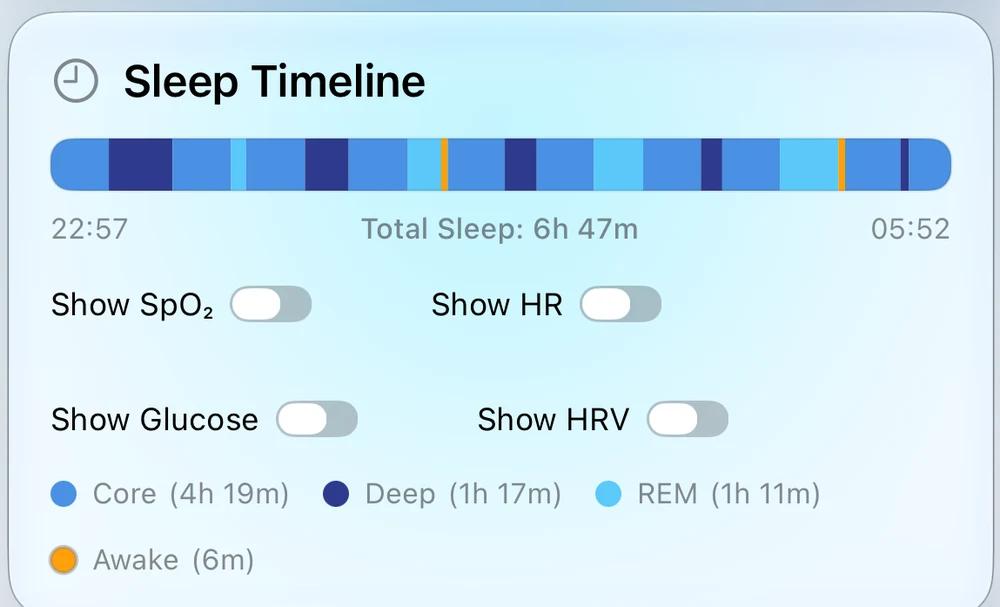
Last night might have been short. The thermometer on the right is what your body is actually carrying into today.
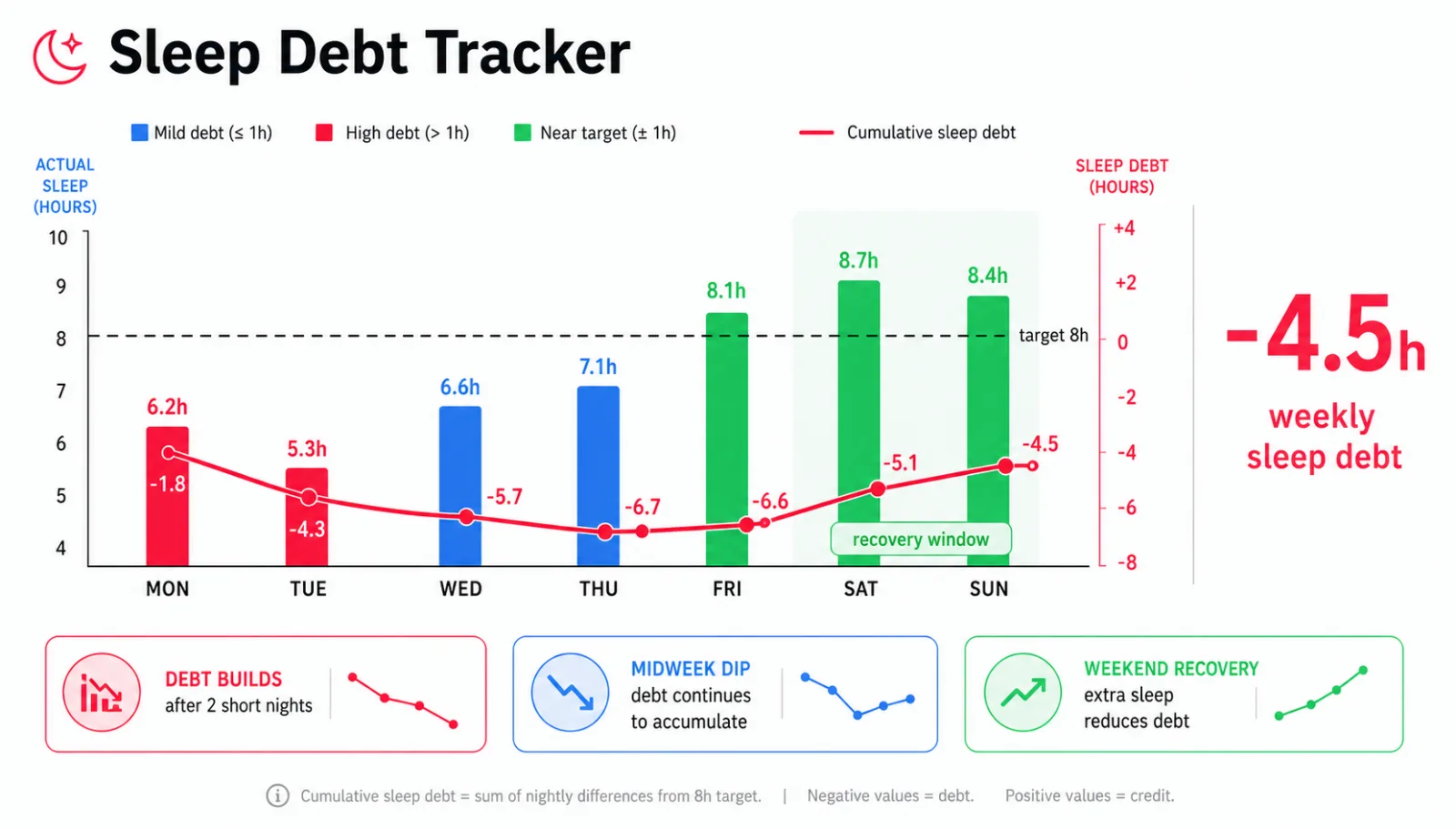
A single rough night isn't debt. The rolling window is - and it's what the body is actually carrying into the next day.

Sleep restriction is one of the most-studied stressors in human physiology, and the consistent finding is this: the cost compounds. Van Dongen and colleagues studied people who slept six hours a night for two weeks. Their mental performance fell to a level seen after forty-eight hours without sleep. Most participants rated themselves as "only a little tired." The body kept the receipt; subjective awareness didn't.
That's why a single-night view is misleading. You can sleep eight hours and still be running on the previous four nights. A rolling window - seven days, the standard in the research - is the shortest unit that captures how the deficit is actually felt.
Body Insights reads your sleep records on this scale by default. The shape of the week is the signal.
Researchers have studied sustained sleep loss for decades. Dawson and Reid published one study in Nature in 1997. Williamson and Feyer followed in 2000 in Occupational and Environmental Medicine. These studies compared sleep loss with blood-alcohol effects on reaction time and judgment. Many later studies have examined the same link.
The headline ("being chronically underslept is like being legally drunk") is a real finding, but it's a careful one. The exact equivalence depends on the task, the person, and how the deprivation was structured. The practical result is clear. After a week of sustained sleep loss, reaction time and judgment get worse. In lab tests, the pattern can look like mild intoxication.
We don't publish a number alongside your week. The point isn't a score - it's that the cost is real, and your body is the one paying it.

Sleep debt isn't a credit card. A long recovery night helps in measurable ways. But a weekend lie-in does not clear every effect of sustained sleep loss. Some metabolic markers take longer to recover. Insulin sensitivity and parts of mental performance can also lag. This can continue after you feel rested.
So we won't tell you the debt has been "erased." We'll tell you the rolling window is lighter than it was. We'll tell you which direction it's trending. We'll tell you, gently, when the pattern says: this isn't a one-night fix. The recommendation that follows is usually about pacing - not pushing harder, not trying to bank the perfect night, but stopping the slow add.
Free for core features. No card needed.
Everything below is what an honest sleep debt tracker should tell you. If you're shopping comparisons, you're in the right place.
The sleep debt tracker reads sleep data from Apple Health - the same records your Apple Watch already writes there overnight. Your Apple Watch tracks. We translate.
The gap between how much your body needed and what it actually got. Quality counts - a fragmented night doesn't fully cancel a deficit.
The standard research window. Long enough to see a pattern, short enough that recent nights still matter.
A long, deep night reduces the rolling load. The pattern softens; we don't claim it disappears.
Whether the rolling deficit is climbing across weeks, easing back, or holding steady - qualitative, not a percentage.
Sleep need varies. After two weeks of your data, we learn yours rather than assuming the textbook number.
One sentence that ties the week to today: "More in the bank than you thought" or "This week is catching up with you."
The short version: yes, in a careful sense.
Dawson and Reid ran controlled trials published in Nature in 1997. They compared extended wakefulness with measured blood-alcohol levels. Reaction time matched mild intoxication after about 17-24 hours awake. Williamson and Feyer extended the finding in 2000. Their study used performance tests from occupational safety. Later work has refined the comparison. The exact match varies by task and by person. It also differs between total sleep loss and chronic partial sleep loss.
What's robust across all of it: sustained sleep deficits measurably impair reaction time and judgment. The most popular framing ("a week of six-hour nights equals being legally drunk") oversells a specific number. The underlying finding doesn't need the oversell.

If you've tried the others and they didn't fit, here's where we differ.
| Apple Sleep | Whoop / Oura | Body Insights | |
|---|---|---|---|
| Last-night view | Yes | Yes | Yes |
| 7-day rolling debt | No | Partial | Yes |
| Honest about recovery limits | N/A | No | Yes |
| Plain-language morning | No | Partial | Yes |
| Tuned for variable energy | No | No | Yes |
| Subscription | None | $6-30 / month | Free for core |
| Extra hardware | None | Ring or strap | None |
Whoop and Oura built careful products - for athletes pushing strain into recovery. If your week doesn't follow a training cycle, you'll find the framing here closer to fit.
The rolling shortfall between the sleep your body needed and what it actually got. One bad night isn't debt. A week of them is - and it's what the body is carrying into today.
It's the standard research window for measuring the cumulative cost. Long enough to show a pattern, short enough that this week still matters more than last month.
Partly. A long recovery night lightens the rolling load. Research suggests some cognitive and metabolic effects linger past what a lie-in repairs. We don't promise to undo it - we surface it so you stop adding to it.
The findings from Dawson and Reid (1997) and Williamson and Feyer (2000) compare sustained deficits to mild intoxication on reaction-time tasks. The exact equivalence varies - the underlying impairment is real.
Not for sleep debt. It reads what your Apple Watch already records. CGM data enriches other parts of the app, not this one.
Free for core sleep debt features. A premium tier adds deeper personalization. No card needed to start.
On-device. No account. No subscription required. No data sold. Ever.

Free for core sleep debt features. Premium adds deeper personalization.