HRV trend
The slope of your heart rate variability across recent weeks, read against your own baseline. Persistent down-drift is the loudest early signal.

Burnout Early Warning · 2-4 week lead
Apple Watch data can show signs of overtraining and burnout before you feel them. HRV declines. Resting heart rate climbs. Sleep stops paying you back. These changes can appear 2-4 weeks earlier. Body Insights reads that pattern and flags it early.
Burnout is not an overnight event. It's allostatic load compounding - small daily costs that don't get paid back, week after week. Long before you'd describe yourself as burnt out, the autonomic nervous system has already been telling on the body. Heart rate variability drifts down. Resting heart rate drifts up. Sleep takes longer to do its work. None of it shouts. All of it is recorded.
That gap - between when your body knows and when your mind admits it - is where so many of the worst crashes happen. You push through a week that looked fine on paper, the wall arrives, and you lose a month getting back.
A useful early-warning read has to look at trend, not a day. Overtraining and burnout share much of the same physiology. The body responds to many types of stress. That includes marathon training, work deadlines, a relapse, or a new baby.
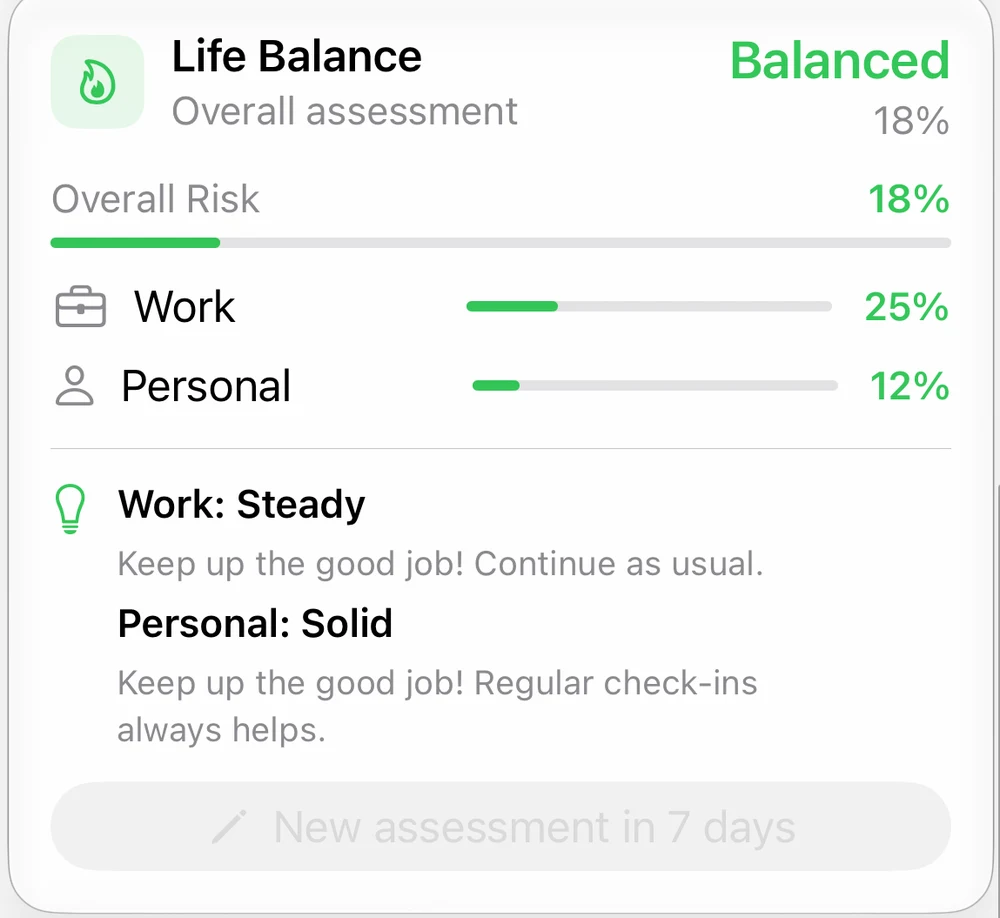
Built for caregivers and people with high-stress work. It also supports ME/CFS, Long COVID, chronic Lyme, and chronic EBV. The same applies to fibromyalgia, POTS, autoimmune flares, and perimenopause. It can also help during recovery from illness. In each case, stress can build before you notice it.

Body Insights reads three trends across a rolling multi-week window and combines them into a weekly burnout read. HRV chronic suppression is the loudest - a persistent down-drift in heart rate variability against your own baseline. Resting heart rate elevation is next - your body asking for more cardiac output to do the same job. Sleep debt accumulation rounds it out, paired with how many true recovery nights you actually got.
The read lands in plain language. "Three of the last four weeks have shown chronic HRV suppression. Pull a recovery day this week." The pattern is there if you want to dig in. The recommendation is in words.
Free for core insights. iPhone + Apple Watch. No card needed.
Burnout caught the morning you collapse is not caught. It's confirmed. Late recognition can cost you weeks afterward. With chronic illness, it can lead to a flare or infection. Recovery can then last longer than the original problem warranted.
Two to four weeks of warning is enough time to do something small while small still works. A recovery day. A meeting deferred. One workout cut. A real night of sleep prioritized over a screen. The actions that catch burnout early look almost laughably modest. The actions required late do not.
This is the difference between a daily-readiness framing and a multi-week trend framing. A readiness score tells you about today. The trend read tells you about the month you're quietly building.

Below, you can see what the read uses and what the research says. You can also compare it with other apps.
Reads from Apple Health - the same HRV, resting heart rate, and sleep data your Apple Watch already writes there. No extra hardware. Nothing leaves the phone.
The slope of your heart rate variability across recent weeks, read against your own baseline. Persistent down-drift is the loudest early signal.
Resting heart rate drifting upward across weeks. The body asking for more cardiac output to do the same work is rarely random.
Cumulative shortfall across recent weeks, plus how many true recovery nights you actually got. A bad week is normal. A bad month is a pattern.
The ratio of physiological stress to recovery time. Load going up while recovery goes down is the textbook setup.
HRV slope is interpreted against your recent norm - not an athletic population mean. Built for bodies that don't follow a training cycle.
The output is a sentence, not a dashboard. "Pull a recovery day this week." The pattern underneath is there if you want it.

The math is harder when your baseline is already elevated. This can happen with ME/CFS, Long COVID, chronic Lyme, or chronic EBV. It can also happen with fibromyalgia, POTS, dysautonomia, or autoimmune conditions. Perimenopause and post-viral recovery can affect it too. Your nervous system is already paying for the underlying condition. The headroom before stress translates into a cascade is smaller. The signs of overtraining show up sooner, and recovery takes longer.
Most overtraining and recovery apps were built on healthy-athlete data. They assume you start each cycle at full. They treat rest as deficit. For a body that lives on the edge of its envelope, that framing doesn't just miss the read - it actively makes things worse.
Body Insights tunes the same physiological signals to a variable baseline. The recommendation, every time, leans toward less. The IOM's ME/CFS energy-envelope work - and the broader pacing literature for post-viral fatigue - sits underneath how this reads. Rest is part of the plan. It is not a failure of it.
The warning is information. It is not a verdict and it is not panic. The recommended responses scale with the read.
Pull one true recovery day into the week. Move the workout that was optional. Get to bed an hour earlier on three of the next seven nights.
Cut training and effortful work by roughly half for two weeks. Treat this week the way you'd treat a week with a mild illness. Defer what can be deferred.
Stop training. Limit work to what is genuinely non-negotiable. Talk to someone you trust. If you have a clinician, this is the kind of pattern worth bringing to them.
There is no version of this read that tells you to push through. The framing is pacing. The framing has always been pacing.
You're probably here because one of these didn't fit. So here's a direct comparison.
| Apple Watch alone | Whoop | Oura | Symptom apps | Body Insights | |
|---|---|---|---|---|---|
| Multi-week HRV trend | Limited | Yes | Yes | No | Yes |
| Multi-week RHR trend | Limited | Yes | Yes | No | Yes |
| Multi-week burnout lead time | No | No (daily strain) | No (daily readiness) | No | 2-4 weeks |
| Tuned for chronic illness | No | No (athletic) | No (athletic) | Partial | Yes |
| Plain-language alert | No | Partial | Partial | Manual | Yes |
| Extra hardware | None | Strap | Ring | None | None |
| Subscription | None | Monthly | Monthly | Mixed | Free for core |
Whoop and Oura are real products made by careful people. They were built for a reader tuning training load or chasing optimization. If yours is a body whose stress doesn't follow a training cycle, this one was built for you.
A few of the studies underneath the read.
Thayer and Lane's model describes HRV as a window into autonomic load. Broader research on vagal tone supports this view. Research on work stress often finds that HRV stays suppressed across several weeks.
Lehrer and colleagues studied resonance breathing and vagal training. Newer HRV studies have also followed healthcare workers. They found that HRV trends match self-reported burnout scores. This pattern can appear weeks before people feel a collapse.
The steady literature on cumulative sleep restriction and HPA-axis dysregulation. Recovery nights matter; their absence matters more.
The IOM/NAM ME/CFS reports and the broader pacing literature for post-viral fatigue. Rest is part of the plan - not a failure of it.
Where the research is firm, we lean on it. Where it is early or contested - particularly the lead-time precision of any single wearable signal - we say so.
Apple Watch measures HRV, resting heart rate, and sleep. Body Insights reads these signals as a trend across several weeks. It flags the pattern that often comes before burnout. This is usually 2-4 weeks before you notice symptoms. We surface the pattern. We don't diagnose.
They overlap in the physiology, and a wearable cannot tell them apart. Body Insights is not a diagnostic tool. Please talk to a clinician if low mood or hopelessness persists. Do the same if you have thoughts of self-harm. A watch cannot answer those questions.
Yes. The signs of overtraining and the signs of life-stress burnout share the same physiological substrate. Caregiving, high-stress work, and illness recovery can show the same HRV / RHR / sleep-debt cascade.
The internal target is flagging the pattern 2-3 weeks before subjective symptoms appear. Some readers see it sooner. The earlier read costs nothing - the recommendation at the early band is one extra recovery day.
No. Body Insights reads from Apple Health. iPhone + Apple Watch is enough. If you wear a CGM, overnight glucose stability folds in. If you don't, the read still works.
On your phone. That's it. No cloud, no account, no third-party sharing.
Your HRV, your RHR trend, your sleep debt, the pattern that's building. None of it leaves the phone unless you explicitly export it.

Body Insights surfaces patterns of physiological stress. It does not diagnose clinical burnout. It also does not diagnose depression, anxiety, or any psychiatric condition. If you are struggling, please talk to a clinician. A wearable can be useful information for that conversation. It is not a substitute for it.
Free for core insights. Reads from Apple Health. iPhone + Apple Watch.
