On-device model
Apple's Foundation Models framework. Runs on your iPhone's neural engine. No network call, no fallback to a cloud model.
AI-Powered Insights · On-device, no cloud
Body Insights uses Apple Intelligence to translate what Apple Health already holds into one readable sentence. The AI runs on your iPhone. Your data stays on your iPhone. There is no cloud, no account, and nothing sold to anyone.
You are reading this because you live in a body that doesn't follow the rules an AI fitness app expects. ME/CFS, long COVID, perimenopause, autoimmune flares, dysautonomia. Energy that swings. Mornings that lie.
The last thing that body needs is its data uploaded somewhere it can't reach. Insurance is one accidental disclosure away. Employers are not your friend. Most "AI health app" entries in the App Store quietly funnel your wearable data to a server, run a model, and send a string back. Body Insights does not.
Apple Intelligence - the on-device AI Apple shipped with iOS 26 - runs entirely on your iPhone's neural engine. The model never connects to a server to read your sleep, your heart rate variability, your glucose, your cycle. There is no opt-in to "improve the product." There is nothing to opt out of, because nothing leaves.

The AI is a translator. Nothing more, and that is the right scope for it.
The numbers behind your morning summary are not generated by AI. Deterministic logic computes them. It reads your HRV, resting heart rate, sleep stages, and cycle phase. If you wear a CGM, it also reads your overnight glucose. Those calculations are math, not guessing. They produce a state - light day, take it slow, more in the tank than usual.
The AI's job is to turn that state into a sentence you'll actually read at 7am. "Last night was lighter than usual. The drop in deep sleep tracked your late dinner." Not a number. Not a paragraph of generic wellness copy. One sentence written from your data.
The AI does not diagnose anything or replace a clinician. It does not tell you to push through. It does not claim to predict the future. It does not invent data your wearable did not record.
Apple Watch and your CGM measure. Heart rate, motion, sleep stages, glucose. The sensors do that job.
Apple Health stores. Encrypted on your device. You decide what apps can read it.
Body Insights reads and synthesizes. Pulls the metrics that matter, runs the math, finds the patterns specific to bodies whose recovery doesn't follow a training cycle.
Apple Intelligence translates. One sentence, on-device. The same iPhone that recorded it writes the summary.
No server. No upload. No third party.
Free for core features. Apple Intelligence runs on-device, opt-in.
Everything below is what a careful person should ask of an AI health app before installing it. If you're comparing tools, this is the section that matters.
Apple's Foundation Models framework, the same neural engine Apple uses for system features, called locally from inside the app.
Apple's Foundation Models framework. Runs on your iPhone's neural engine. No network call, no fallback to a cloud model.
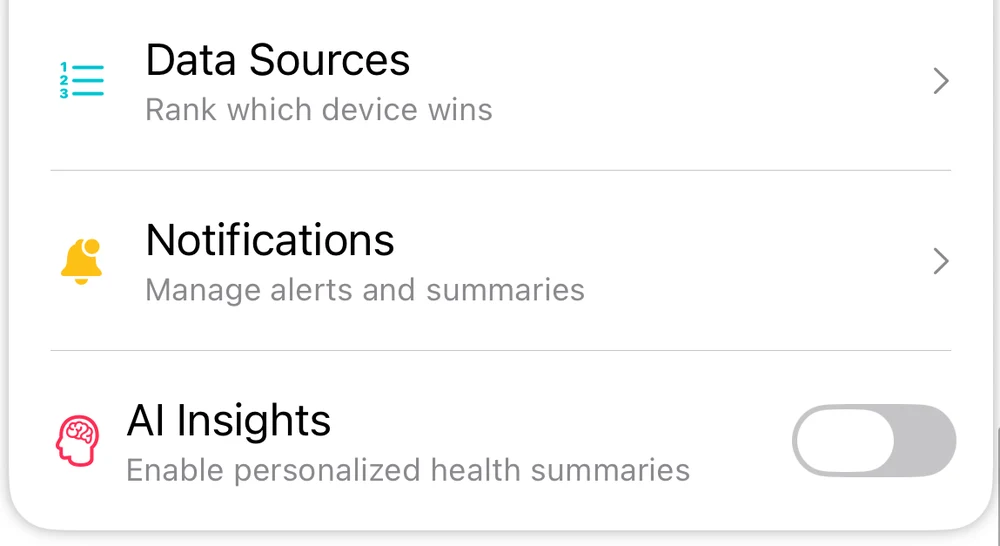
AI is off until you turn it on in Settings. If you never enable it, the app gives you the same insights with a template-written summary.
Prompts are short, structured, and bounded. Instruction, your data, tone, length limit. No open-ended chat. No room to hallucinate a diagnosis.
The score, the trend, the pattern - computed by formula. The AI only writes the sentence on top.
If your iPhone doesn't support Apple Intelligence, or you disable it, hardcoded plain-language templates fill in. Nothing breaks.
Apple's on-device models do not train on user data. We never see your data either - the app's logic runs locally and so does the model.
AI written summaries are useful at exactly one job: turning a state your body is already in into a sentence you can read while the kettle boils. That is the boundary.
It cannot diagnose. ME/CFS, long COVID, fibromyalgia, and POTS are clinical diagnoses. Pattern recognition from a wrist sensor cannot replace a clinician's exam, lab work, or your history. The app's job is to give you a clearer record to walk into that appointment with.
It cannot replace your doctor. If a pattern looks like sleep apnea, the app surfaces it and tells you to bring it up. It does not prescribe a CPAP. If a trend looks like burnout building over weeks, the app names what it sees and what you might consider. It does not write you a leave-of-absence note.
It cannot predict tomorrow with certainty. The early-warning signals are pattern shifts a few days or weeks ahead of conscious awareness. Useful, not infallible.

The category is crowded. The honest differences are not about model quality. They are about where the model runs and who else gets a copy of your data.
| Most AI health apps | ChatGPT / Gemini health chats | Body Insights | |
|---|---|---|---|
| Where AI runs | Cloud server | Cloud server | Your iPhone |
| Account required | Yes | Yes | No |
| Health data uploaded | Yes | Yes, with each message | Never |
| Reads Apple Health directly | Sometimes | No | Yes |
| Tuned for chronic illness | Rare | No | Yes |
| Subscription | $5-30 / mo | $20+ / mo | Free for core |
If you expect an AI health app to keep your most private biometric data off a server, it must run on your device. No other architecture meets that standard.
Yes. Apple Intelligence runs on-device. No account, no cloud, no server-side processing, no data sold. The privacy claim is architectural - not a policy promise.
No. Apple's on-device Foundation Models, called locally. Your data is never sent to OpenAI, Anthropic, Google, or any third party.
No. It surfaces patterns and writes plain-language summaries. Diagnosis stays with your doctor. The app helps you walk into that conversation with better notes.
One readable sentence in the morning, plus longer summaries for sleep and stress when you ask for them. The underlying numbers are deterministic math.
Apple Intelligence needs iOS 26 and a compatible iPhone. On older devices, the app still works - you get template-written summaries instead of AI-written ones.
Core features are free. AI-written summaries are part of the premium tier, opt-in, and processed entirely on your device.
On-device. No account. No cloud. No data sold. Ever.

The architecture does the work. Your data stays where it started.