Period days - especially heavy ones
Iron loss, low ferritin, and a body already managing inflammation. Fasting on top of that tends to spike cortisol and worsen the cramping. Eat.
Fasting Readiness · Should I fast today
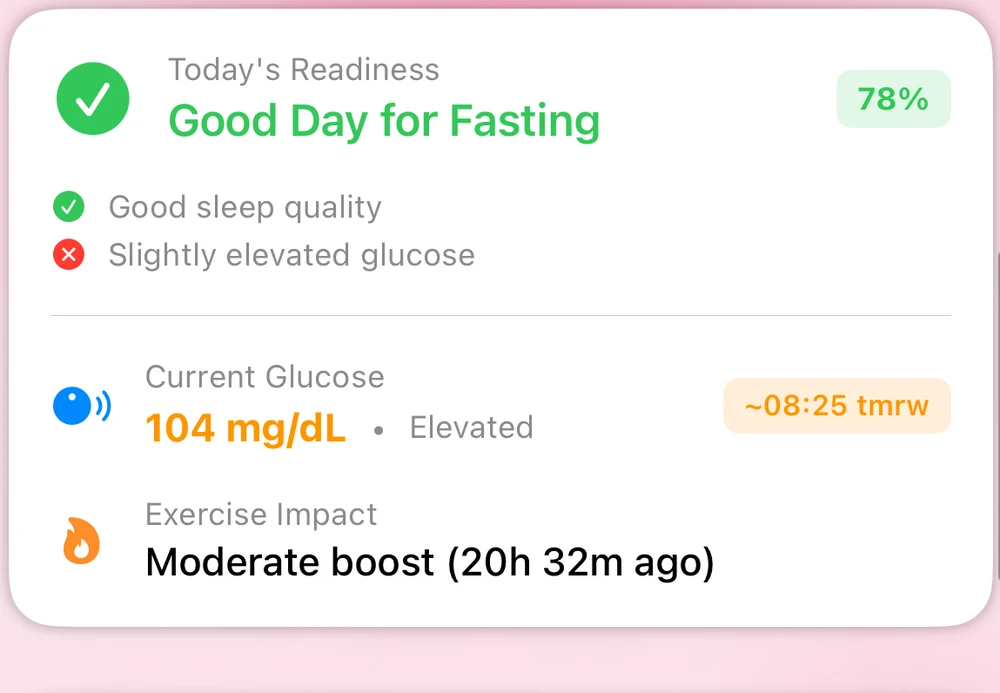
Body Insights reads last night's sleep, HRV, cycle phase, and overnight glucose. It then tells you whether to skip breakfast or eat early today.
Most fasting advice treats your body like a thermostat. Set the window - 16:8, OMAD, whatever - and obey it. Discipline equals progress.
But you've noticed the days don't all feel the same. Some mornings a longer fast feels easy. Some mornings, by 10am, your hands are shaking and your jaw is tight and the day falls apart. Same protocol, different bodies, different days. The protocol isn't the variable. You are.
Body Insights reframes the question. Should I fast today isn't a willpower question. It's a readiness question - and your Apple Watch already recorded the answer overnight.

Most fasting apps ignore cycle phase entirely. That's a problem - because the same 16-hour fast that feels effortless on day 8 can feel punishing on day 25, and the reason isn't in your head.
Follicular days generally bring better insulin sensitivity, steadier glucose, and stronger fasting tolerance. Progesterone rises during late luteal days. Glucose tolerance falls, cortisol can become more reactive, and sleep often gets worse. Menstrual days bring iron loss, fatigue, and a body asking for fuel earlier.
If you log your cycle in Apple Health, Body Insights reads phase as one of the inputs. Perimenopausal patterns are read as their own thing - cycles getting variable doesn't mean phase stops mattering. It means we widen the lens.
Most fasting content sells you on the upside and stays quiet on this part. We'll lead with it. These are the days Body Insights flags as eat-breakfast days, every time:
Iron loss, low ferritin, and a body already managing inflammation. Fasting on top of that tends to spike cortisol and worsen the cramping. Eat.
Short or fragmented sleep impairs insulin sensitivity and elevates sympathetic tone the next day. Adding a fast layers stress on stress. Eat early.
If RHR is climbing, HRV is dropping, and you feel off - your immune system is already working. Don't ask it to fast at the same time.
ME/CFS crash, long COVID setback, autoimmune flare, POTS bad day, fibromyalgia pain day. Fasting is a stressor. Flares mean your stress budget is already spent.
The week before your period, especially if PMDD is part of your picture. Glucose tolerance dips. Mood is fragile. Fuel helps more than it hurts.
Not days - whole seasons. The body is doing other work. Skip the fasting experiment until the season ends.
This is the layer most fasting apps don't touch. Your fasting glucose this morning, and how stable it's been across the past week, says more about whether today is a good fasting day than any clock-based rule.
Stable, in-range mornings suggest that the metabolic system is resilient. A longer fast is then likely to be well tolerated. Unusually high fasting glucose, or a week of erratic readings, suggests the system is already under load. Pushing a fast on top of that tends to worsen the pattern, not improve it.
Without a CGM, this layer drops out cleanly and sleep, HRV, and cycle phase carry the read.

Free for core features. No card needed.
Fasting is a hormetic stressor. A small, well-timed stressor that the body adapts to and grows stronger from - if it lands on a resilient day. On a depleted day, the same stressor doesn't build resilience. It erodes it. The literature on this is consistent.
All inputs come from Apple Health - the same data your Apple Watch, iPhone, and any connected CGM already write there.
Short or fragmented sleep is the single strongest signal to push breakfast earlier. Poor sleep impairs insulin sensitivity the next day.
Compared to your personal trend, not a population number. A low HRV night means the autonomic system is asking for parasympathetic support - not another stressor.
RHR climbing across multiple nights flags brewing illness, overreaching, or stress. We flag it before you feel it.
Follicular, ovulatory, luteal, menstrual - or the variable patterns of perimenopause. Read from Apple Health if you log it.
If you wear a CGM. Stability across the past week matters as much as this morning's number.
One sentence. "Today is a good day for a longer fast." Or "Eat breakfast today - sleep was short and HRV is below your baseline."
This is a generalization, not a rule. Your body's pattern is what we actually read - this just gives you the lens.
Follicular (roughly day 1-14). Estrogen rising. Insulin sensitivity generally better. Sleep tends to be deeper. Longer fasts are typically well tolerated - on rested days.
Ovulatory (mid-cycle). A brief energetic window. Most people tolerate fasting well here, but cortisol can be reactive - honor what your body says.
Luteal (roughly day 15-28). Progesterone rising. Body temperature up. Sleep often lighter. Glucose tolerance drops in the late luteal phase. Shorter fasting windows are kinder.
Menstrual (day 1-5). Iron loss, inflammation, fatigue. Most people do better with an earlier breakfast and a protein-anchored meal. Fasting is not the priority this week.
Perimenopause. Cycles become variable; phases blur. We read whatever data is there - sleep, HRV, glucose - and weight phase less heavily when it's not reliable.

You're probably here because a timer app wasn't enough. Here is how the options differ.
| Zero / Fastic / Simple | Generic readiness apps | Body Insights | |
|---|---|---|---|
| Fasting timer | Yes | No | Yes |
| Daily fast/don't-fast answer | No | Partial | Yes |
| Reads cycle phase | No | Rarely | Yes |
| Overnight glucose fusion | No | No | Yes |
| Tuned for chronic illness | No | No | Yes |
| Subscription | $10-15 / month | $6-30 / month | Free for core |
| Extra hardware | None | Often a ring/strap | None |
The fasting-timer apps were built for healthy adults running a protocol. The generic readiness scores were built for athletes tuning training load. If yours is a body navigating chronic illness, perimenopause, or a recovery arc that doesn't follow a clean training cycle - this one was built for you.
It depends on what your body did overnight. Short sleep, low HRV, unstable overnight glucose, or a flare day are all reasons to eat early. Body Insights reads those signals from Apple Health and answers in one sentence.
Avoid fasting on heavy period days or during late luteal days with PMDD or strong PMS. Avoid it during pregnancy, while breastfeeding, after poor sleep, when sick, or during a chronic-illness flare. Also avoid it if you have a history of disordered eating.
Sometimes, on the right days. Flare days are not those days. Coordinate with your clinician - Body Insights is information, not medical advice.
Yes. Follicular generally tolerates longer fasts better. Late luteal and menstrual days are kinder with earlier breakfasts.
No. Without one the glucose layer drops out and sleep, HRV, and cycle phase carry the read. With one, you get a layer most fasting apps don't read at all.
Free for core daily insights, including the morning fasting answer. Premium adds deeper analytics. No card needed to start.
On-device. No account. No subscription required. No data sold. Ever.

Free for core daily insights. Premium adds deeper analytics and predictive features.
