
Body Insights
See what changed in your Apple Health data.
Body Insights reads Apple Health data from Apple Watch and translates it into energy, recovery, and pacing guidance.
Read my health patternDiabetes looks like a sugar problem. Underneath, it is an energy problem.
Type 2 diabetes is often viewed through one number: blood glucose. High is bad. Lower is better. That view is not wrong, but it stops at the symptom. It does not ask what failed first.
A different picture appears at the cell level. Type 2 diabetes is a disease of failed mitochondrial energy. It also brings poor fuel switching. The cells that release insulin run short of clean power. Other cells stop responding to the insulin signal. Blood sugar rises because this machinery has stalled.
One cause is present in every glass of water. It is deuterium, a heavy form of hydrogen. Deuterium helps cause the cell's energy crisis. The disease also produces more of it. This link is a growing area of metabolic biology. It reframes diabetes as a lack of clean energy. High sugar remains the visible symptom.
Deuterium is the heavier twin of ordinary hydrogen. One extra neutron doubles its mass. It enters food and water where light hydrogen would. Its added weight can jam molecular engines that use hydrogen. The companion article explains deuterium and your mitochondria. Here, the path leads into the pancreas.
The pancreatic beta-cell runs on an energy switch
Start where insulin is made. Each pancreatic beta-cell has an energy-based trigger. It turns food into a hormone signal.
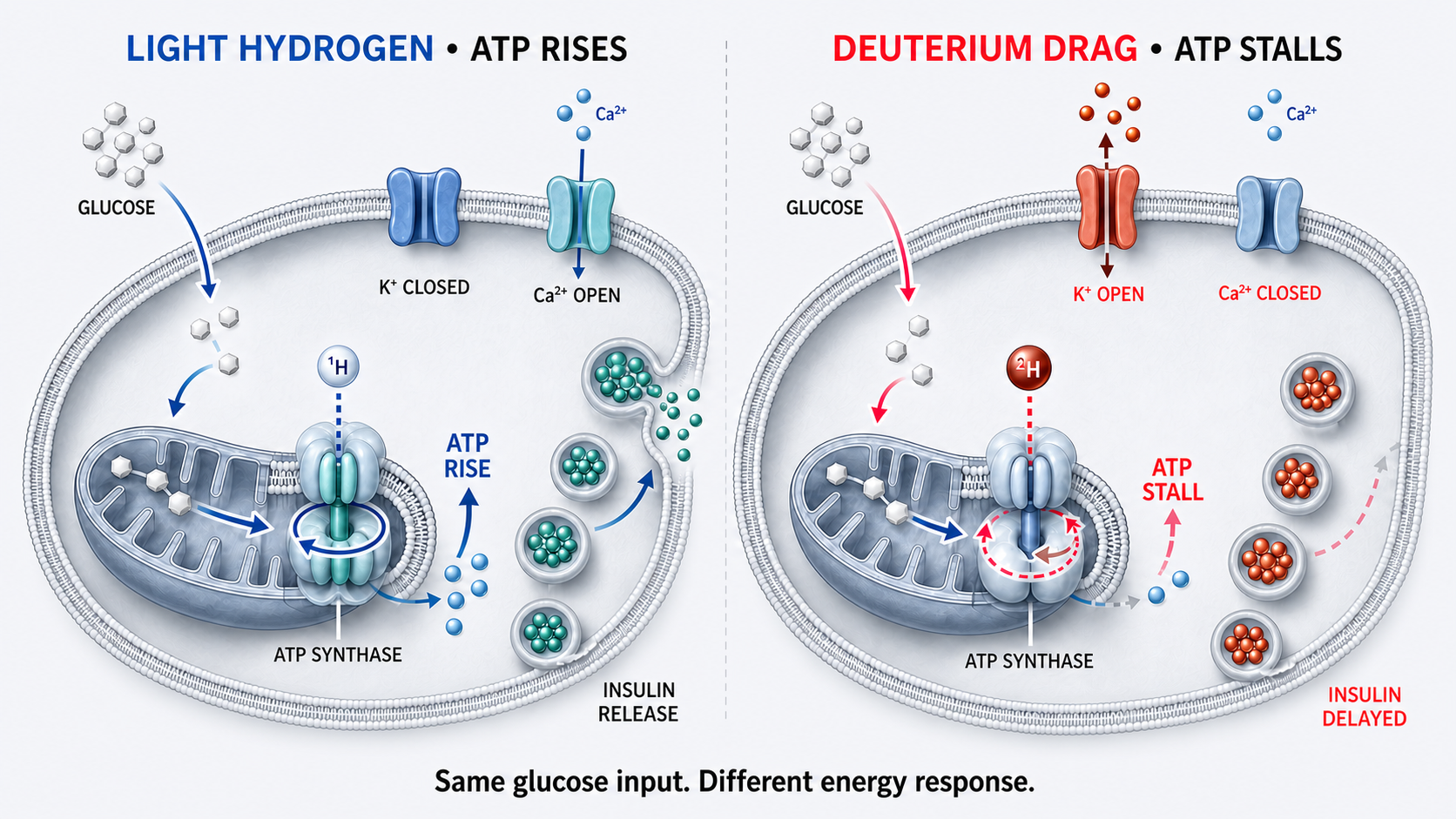
Glucose enters the beta-cell. Mitochondria burn it and produce a sharp rise in ATP. ATP is the cell's energy currency. The rise closes potassium channels. This changes the voltage across the cell membrane. Calcium channels then open and insulin is released. The sequence needs a clear rise in cellular energy.
Now add heavy hydrogen to those mitochondria. At levels above roughly 150 parts per million, deuterium stalls ATP synthase. These spinning motors sit inside the beta-cell. They help create the needed energy rise. Call the stall a deuterium stutter. The motors drag, so ATP does not reach its trigger point. Potassium channels stay open. The membrane then fails to fire as expected.
The result is a painful mismatch. Blood glucose is high, but the beta-cell cannot answer well. Insulin release becomes slow and poorly timed. The cell has glucose. It lacks the clean energy needed to act on it.
High blood sugar becomes a deuterium trap
The damage does not stay in the pancreas. Insulin resistance leaves more glucose in the blood. The chemistry of that glucose then matters.
Carbohydrates carry the highest deuterium load among food groups. Their level is near 150 ppm. Insulin-resistant cells cannot clear this heavy glucose well. It stays in the blood and causes more harm over time. It glycates proteins and stiffens tissue. It harms the inner lining of blood vessels. It also weakens systems that manage the body's water. Those systems would otherwise help dilute the deuterium load.
The vascular system is already short of energy. It now holds a heavy fuel that is hard to burn. High blood sugar marks the disease and deepens it. It becomes a deuterium trap.
Then fat-burning collapses, and the lock clicks shut
Advanced type 2 diabetes often brings lost metabolic flexibility. This means the body struggles to switch fuels.
A healthy metabolism can switch fuels. It burns carbs when they are available. It turns to fat when they are not. A diabetic cell can lose that switch. It then stays in a carbohydrate-burning state. The deuterium model explains why this state can persist.
The two fuels are not isotopically equal:
- Carbohydrates hold high deuterium, near 150 ppm. Burning them sends heavy hydrogen into the mitochondrial matrix. This adds to the nanomotor stalls.
- Clean fats hold less deuterium, around 110 to 120 ppm. Beta-oxidation avoids early, deuterium-heavy steps in sugar metabolism. It also makes fresh metabolic water with less deuterium. This water can dilute the cell's environment.
This closes the trap. A cell that cannot burn fat makes less low-deuterium water. It loses its main way to lower its own level. Cellular deuterium then stays high and may keep rising. Each rise makes insulin resistance harder to reverse.
The insulin signal drowns in thick water
One more layer involves the water itself.
Insulin does not simply float to its receptor and dock. It relies on structured, liquid-crystalline water. This is sometimes called exclusion-zone water. The water helps insulin hold its three-dimensional shape. It also helps carry the signal at the cell surface. Hormone and receptor meet through this ordered film of water.
More deuterium disrupts that order. Heavy hydrogen tangles the bonds in the water at the surface. The water becomes thick and disordered. Picture a handshake under syrup. Insulin reaches the receptor, but the needed shape change does not finish. This change is the structural handshake that carries the signal. The hormone and receptor are both present. The thickened water keeps the signal from completing.
The vicious cycle, drawn in full
Together, the four mechanisms form a loop. Each step feeds the next.
High dietary deuterium stalls the pancreatic ATP engines. Insulin release lags. Glucose builds up in the blood and becomes a deuterium trap. The cell loses its ability to burn fat. It then makes less clean, depleted water. Cellular deuterium rises further. That higher load stalls the ATP engines again.
The loop keeps tightening. This explains why willpower alone rarely reverses type 2 diabetes. Medicine can improve a blood-sugar value. Yet the energy crisis may remain. You are managing sugar and trying to break an isotope feedback loop.
The way out runs through the same rhythms
The same levers address both problems. They lower deuterium and restore fuel switching. The levers are ordinary.
Burning clean fats lets mitochondria make depleted metabolic water. This internal water dilutes the matrix and loosens the lock. Fasting can turn the body toward stored fat. The cell then makes more of the same low-deuterium water. Steady, easy movement helps keep tissue supplied with oxygen. These are ordinary parts of metabolic health.
Each lever follows a rhythm. Timing matters for eating and fasting. Steady aerobic work adds another rhythm. Energy and recovery also move from day to day. Apple Watch records related data in Apple Health.
Body Insights reads those rhythms. It compares your fasting windows with your own baseline. It does the same for daily energy and recovery. You can then follow changes from week to week. You will not see a wrist-based deuterium reading. You will see related rhythms that you can act on.
Diabetes looks like a sugar problem. Underneath, it is an energy problem. The path back uses ordinary metabolic habits.
Related reading
- Deuterium and your mitochondria: the heavy hydrogen story. The full mechanism from food to the ATP-synthase motor.
- Fitness age vs real age. What the gap between fitness age and your birthday means.
- Deuterium and Cancer. How heavy hydrogen regulates cell growth and why depleted water slows cancer cells.
Body Insights
See what changed in your Apple Health data.
Body Insights reads the Apple Watch data you already have and turns it into a plain daily read on energy, recovery, and pacing.
Read my health pattern