
Body Insights
See what changed in your Apple Health data.
Body Insights reads Apple Health data from Apple Watch and translates it into energy, recovery, and pacing guidance.
Read my health patternDeuterium is the heavy hydrogen in water
Every glass of water contains deuterium, a heavy form of hydrogen. The usual amount is roughly 150 parts per million.
The ordinary form, protium, has one proton and one orbiting electron. Deuterium adds a neutron to the nucleus. That extra particle raises its mass from about 1 to about 2.
Chemistry depends on electrons, not neutrons. So deuterium can take hydrogen's place in water and food. It behaves much like hydrogen but weighs twice as much. That extra weight changes the reactions that follow.
This is the kinetic isotope effect. A bond with deuterium sits in a lower energy well. It is stronger, more rigid, and harder to break. Mitochondria break hydrogen bonds millions of times each second. Heavy bonds slow that work down.
Why some foods carry more deuterium
Deuterium is not spread evenly through food. The modern food chain can add more of it at several stages.
Plants sort hydrogen isotopes during photosynthesis. Heavy hydrogen moves away from fats and working green tissue. More of it ends up in starches and structural sugars. Sugar therefore starts heavier than fat.
Corn and sugarcane add another step because both use the C4 pathway. This pathway helps them survive hot, dry conditions. Its high-pressure carbon fixation packs more deuterium into glucose. Rice, potatoes, and wild berries use the gentler C3 pathway.
Feedlots carry that load forward. Industrial cattle eat corn and soy pellets instead of grass. Their tissue, milk, and fat sit above 140 ppm. Pastured, grass-fed animals stay below 135 ppm.
Processing heat can raise the level again. Dehydration, distillation, and thermal reduction remove lighter water first. These methods make corn syrup, powdered milk, and juice concentrate. Ordinary water evaporates more easily than heavy water. The syrup left behind becomes richer in deuterium.
Irrigation can have the same effect. Monoculture often uses still reservoirs and open canals. Sun and heat remove the lighter water. Crops then drink the heavier water that remains.
Each change is small, but the whole chain adds up. A heavy crop feeds livestock, then goes through heat and irrigation. The result can exceed the load our biology evolved to handle.
What happens inside mitochondria
Mitochondria make energy through a precise series of steps. Above a critical deuterium level, four parts of that process can fail.
A heavy proton stalls ATP synthase
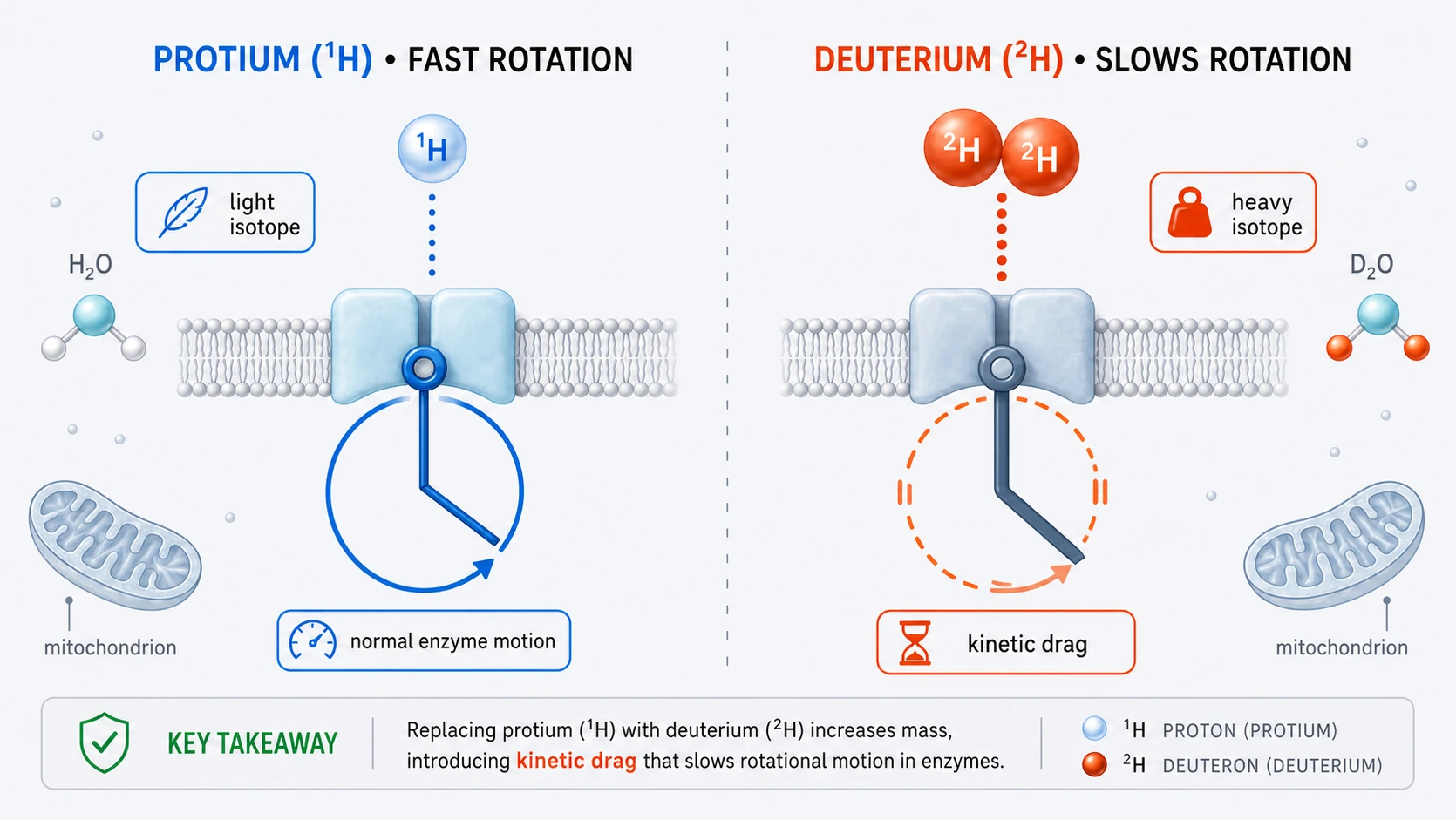
ATP synthase sits in the inner mitochondrial membrane. This molecular turbine can spin at 9,000 RPM. Each turn presses ADP and phosphate into ATP, the cell's fuel. A stream of single, light protons drives it.
A deuteron can enter the same narrow channel. Its mass is double, and its ionic radius is larger. Those differences alter the motor's rotation. It can stutter, drag against itself, or stop.
Repeated mechanical jolts can tire the enzyme. They can also deform its catalytic c-ring subunits. The nanomotor wears under a load it was not built to carry.
The electron transport chain backs up
The electron transport chain strips hydrogen from food molecules. Removing deuterium from carbon takes far more activation energy. Removing light hydrogen takes less.
The kinetic isotope effect causes this slowdown. Dehydrogenase enzymes struggle when a deuterated molecule arrives. Electrons back up along Complexes I, III, and IV. One slow station jams the whole conveyor.
The chain leaks free radicals
A blocked chain starts to leak electrons. They spill early from Complexes I and III. Nearby oxygen then produces bursts of superoxide radicals.
The local stress can overwhelm glutathione and other antioxidant defences. It oxidizes nearby membrane fats too. The damage can reach mitochondrial DNA and cause mutations.
The proton-motive force weakens
Deuterium ions do not act like light protons. Their tunneling and thermodynamic properties are different. Those differences blunt the electrical and pH gradient that mitochondria need.
A weaker gradient makes the cell use more oxygen and fuel. It gets less net ATP in return. The factory runs hotter but makes less energy.
How breath testing measures deuterium
Heavy hydrogen leaves a measurable trace, but blood gives a poor view. Plasma deuterium changes quickly and mostly reflects a recent drink. It does not show the state of your cells.
Exhaled breath condensate offers a cleaner window. You breathe into a chilled collection chamber. The vapour freezes against the glass at once.
That water is a direct product of mitochondrial respiration. Cells make it when hydrogen meets oxygen at the chain's end. Its isotope pattern shows the purity of your metabolic water.
Labs can test the sample with isotope ratio mass spectrometry. Laser spectroscopy also gives an exact parts-per-million result. An undepleted baseline sits around 148 to 152 ppm. Optimization protocols aim for 130 to 135 ppm.
Ways to lower the load
Lowering deuterium means taking in less and helping the body clear more. The same tools also support metabolic health.
Shift more fuel toward fat
Mitochondria make fresh metabolic water during beta-oxidation. This happens when they burn fat. The water is naturally low in deuterium, at roughly 110 to 120 ppm. Pathways that build fat reject heavy hydrogen.
This water dilutes the mitochondrial matrix from within. The approach favours grass-fed tallow, ghee, and wild cold-water fish. Avocado and olive oil also fit. Refined C4 sugars and industrial seed oils sit at the high end. Reduce those instead.
Use fasting windows
During a fast, the body turns to its stored fat. Beta-oxidation then makes the same low-deuterium metabolic water. This can lower the tissue baseline without any outside input.
For most people, meal timing is the most direct handle. It controls when the body eats and when it fasts.
Add cold exposure
Cold immersion activates brown fat. This tissue contains many mitochondria with uncoupling protein 1, or UCP1. UCP1 bypasses ATP synthase and burns fat to make heat.
The faster process makes large amounts of depleted water. It also turns fluid over quickly.
Get morning light
Heavy water can collect inside a cell. The water around its nanomotors then thickens and drags on them.
Early morning sun is rich in near-infrared light. Water absorbs those wavelengths directly. This shifts its hydrogen-bond angles and makes it thinner.
Thinner water creates less friction. Stalled motors can spin again. They can also push heavy isotopes into the space outside the cell.
Do zone 2 cardio
Oxygen is the final acceptor in the electron transport chain. It joins passing protons and electrons to make new water.
Steady, low-intensity aerobic work keeps tissue supplied with oxygen. The last station can keep moving. The metabolic-water factory then makes clean water without a final jam.
What your Apple Watch can show
You cannot read deuterium at home, but you can watch the protocol's routines. Fat use, fasting, cold, morning light, and steady cardio follow daily rhythms. Your watch already records them.
Apple Health holds your fasting times and morning light data. It also holds your aerobic work and overnight recovery. Together, they are the raw material for this protocol.
Body Insights reads those records. It tracks your fasting windows and morning light exposure. It also reads your steady aerobic load. Then it compares your daily energy and recovery with your own baseline.
You will not see a deuterium number on your wrist. You can see whether a routine leaves you more or less recovered each week. That is the feedback you can act on.
Deuterium is heavy hydrogen, and the food chain concentrates it. The response uses ordinary metabolic habits: eating, fasting, movement, and recovery. Your watch already follows those rhythms.
Body Insights reads the recovery and energy rhythms your Apple Watch already records →
Related reading
- Deuterium and diabetes covers the energy crisis under blood sugar. Heavy hydrogen stalls the insulin engines and locks in metabolic inflexibility.
- Fitness age vs real age explains the gap between fitness age and your birthday, plus how to move it.
- Deuterium and cancer explains how heavy hydrogen controls cell growth. It shows why depleted water slows cancer cells.
Body Insights
See what changed in your Apple Health data.
Body Insights reads the Apple Watch data you already have and turns it into a plain daily read on energy, recovery, and pacing.
Read my health pattern