Reads habitual sleep from Apple Health
Pulls the multi-week window of total sleep time your Apple Watch (or other HealthKit-writing tracker) has already recorded. No new logging on your part.

Sleep Age · Where the curve is gentlest
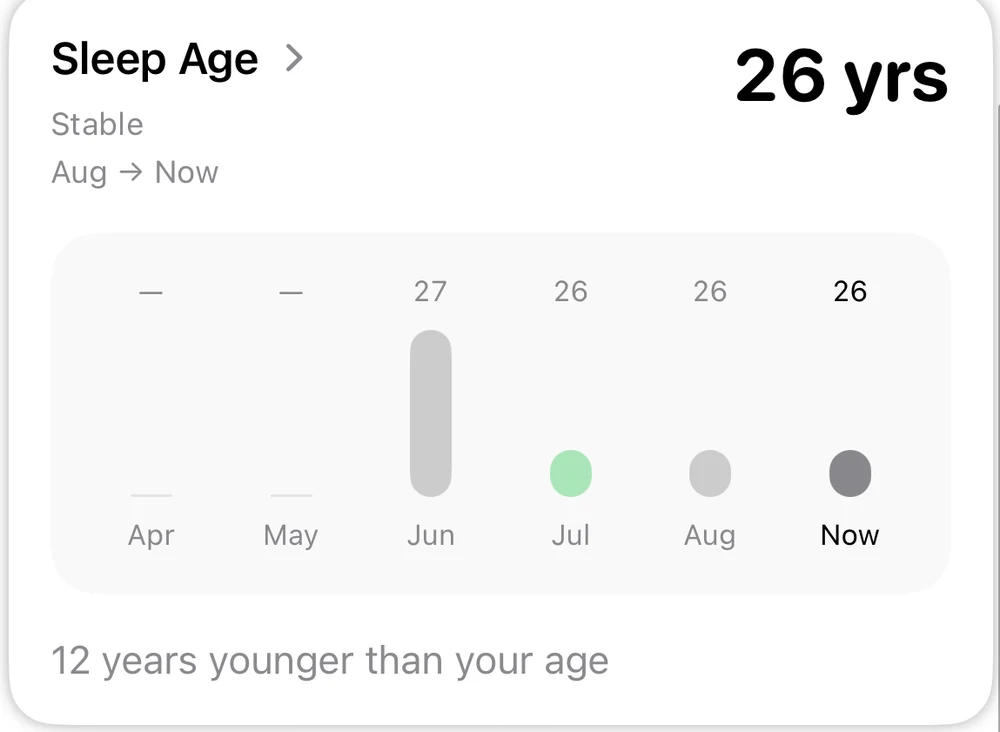
A sleep age calculator built on a U-shaped biological-aging curve. Body Insights reads your habitual Apple Watch sleep, then shows where it sits on a shape that bends up at both ends.
Most sleep age calculators online want one number from you and give one number back. Body Insights does something different: it reads where your habitual sleep sits on a curve, and tells you what the shape says.
The curve is U-shaped. Habitually short sleep appears to drive faster organ aging. Possible pathways include inflammation and insulin resistance. Reduced overnight brain clearance may also play a part. Habitually long sleep usually signals an underlying problem. That can include depression, sleep apnea, or chronic illness. The long sleep may not cause the aging itself. Both ends bend up. The gentle middle is the sweet spot.
Body Insights doesn't prescribe an hour count. It shows you the shape, and shows you where you stand on it.
Sleep duration against biological aging traces a U - gentle in the middle, lifting at both ends. Your habit is the line; tonight is a single point.
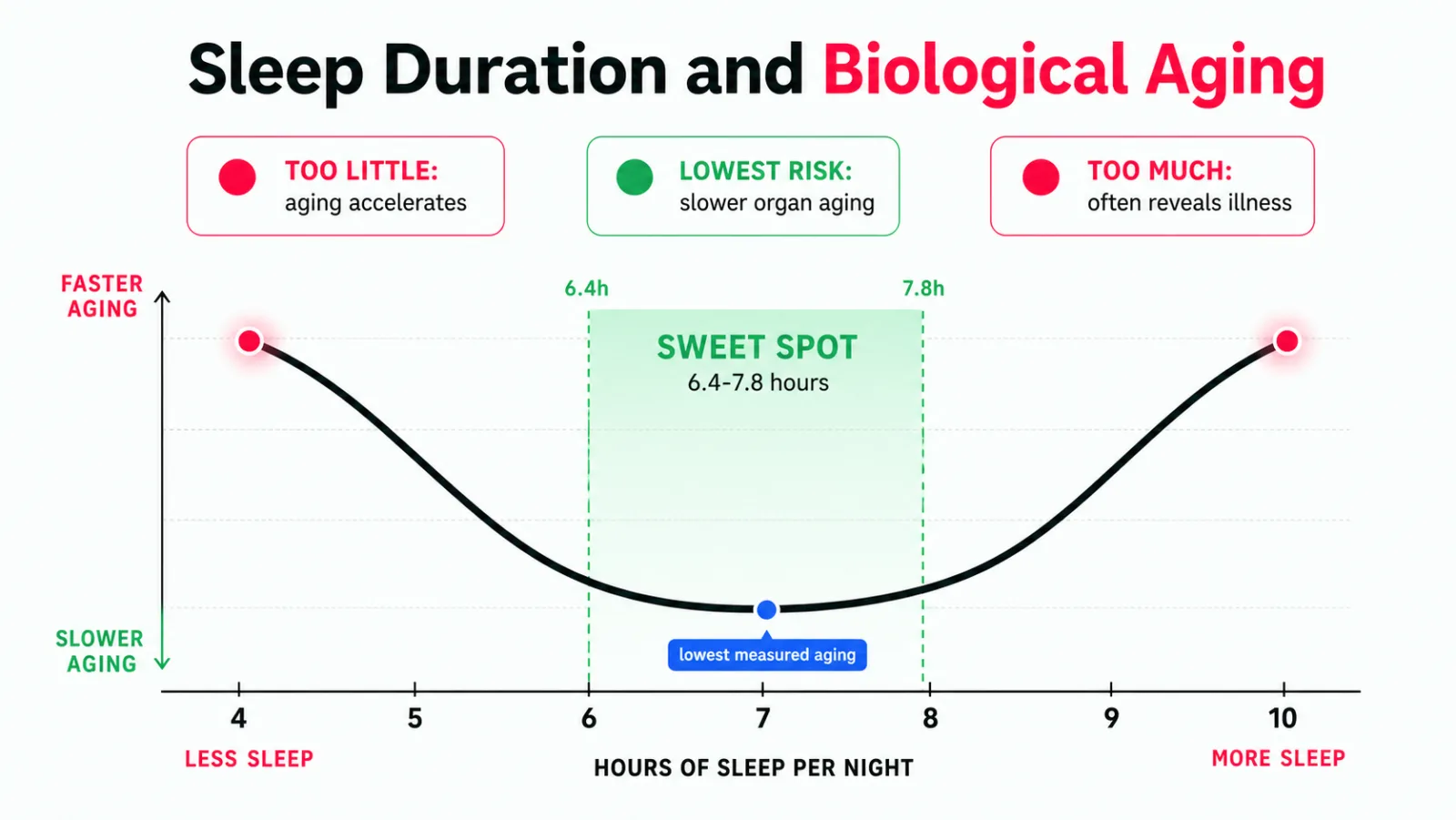
Where your habitual sleep sits on the curve. Tonight is a single point - your habit is the line.
For a long time the conventional wisdom was "more is better" - and then large cohort studies started saying something more complicated. Wen et al. published a large observational study in Nature in 2026. It compared habitual sleep duration with aging markers across nine body systems. The results formed a clear U-shape. Short and long both correlated with faster aging. The middle was gentlest.
What the shape probably means is two different things on each side. The short end has a plausible direct mechanism. Chronic sleep loss keeps inflammation higher. It can leave the brain's overnight clearance unfinished. It can also increase insulin resistance over time. The long end is messier. People sleeping ten hours a night usually aren't sleeping ten hours because they're well-rested. They may sleep ten hours because something is pulling on them. It could be depression, untreated apnea, or chronic infection. An autoimmune flare can do the same.
So the short end likely causes some of the aging it correlates with. The long end likely signals the thing that's causing it. Body Insights treats those two sides differently for that reason.


Sleep age in Body Insights is read from your habitual pattern, not from any single night. A short night after a long flight isn't a chronic pattern. A long night after a hard week isn't either. Both are recovery, or weather, or just a Tuesday - they don't change the shape of your habit.
The marker you see on the curve reflects where your sleep has been settling over a multi-week window. Tonight gets its own dot - a forecast for context - but it doesn't move the line. A basic sleep age calculator may overreact to one night on a hotel mattress. This one reads what your body does across the month.
Free for core features. No card needed.
If you're trying to figure out which sleep age calculator is actually serious about the research, this is the part of the page for you.
Your Apple Watch tracks. Apple Health stores. Body Insights reads and translates the habit into a position on the curve.
Pulls the multi-week window of total sleep time your Apple Watch (or other HealthKit-writing tracker) has already recorded. No new logging on your part.
Your habitual sleep duration becomes a position on the curve. Recent large observational research links sleep duration with organ-level aging.
Short side reads as a behavioural pattern with a plausible mechanism. Long side reads as a signal worth a look, not a prescription to sleep less.
You see where you sit on the shape, with a chip that names the zone in plain language. The curve does the talking; the number is secondary.
A forecast for tonight appears as a separate marker on the chart - context for the habitual marker, never a verdict that overrides it.
Longer sleep during the luteal and menstrual phases is normal physiology, not pathology. Body Insights adjusts the long-side read accordingly, and tells you when it's doing so.
The U-shape comes from a large observational study by Wen et al. It appeared in Nature in 2026. The study used UK Biobank data. It compared habitual sleep duration with aging markers across nine body systems. Both extremes of sleep duration correlated with faster aging signatures; the middle of the range correlated with the slowest.
Body Insights' implementation is informed by this research, not a direct port. The curve drawn in the app is a sanitized representation of the shape, intentionally without specific hour numbers etched into the axis. The study reports duration thresholds. Body Insights does not publish them in the chart. The chart focuses on the shape and where your habit sits. It does not present one cut point as the answer.
Causality is the careful part. The short end has plausible direct mechanisms. These include inflammation and insulin resistance. Reduced overnight glymphatic clearance may also play a part. At the long end, extra sleep tends to mark an underlying problem. That may be depression, sleep-disordered breathing, or chronic illness. The sleep itself may not drive the aging. So the curve is real, but the two sides of it tell different stories.

If your habit sits past the gentle middle on the long side, Body Insights flags it as worth a look - never as a habit to suppress. Long sleep tends to be a symptom, not the disease.
Hypersomnia is a documented depression pattern. Cutting sleep doesn't treat the depression; it removes one of the few signs the body is sending.
Fragmented, low-quality nights can drive a person to sleep longer chasing rest they never get. The fix is the apnea, not less time in bed.
ME/CFS, long COVID, autoimmune flares, post-viral states - all push sleep duration up while recovery happens. This is the body doing its job.
Progesterone is sedating. Longer nights during luteal and menstrual phases are physiology, not pathology, and Body Insights reads them that way.
Most online sleep age calculators are a quiz. A few wearables give you a single sleep-related score. Here is how the options differ.
| Online quizzes | Whoop / Oura | Body Insights | |
|---|---|---|---|
| Reads real sleep data | No (self-report) | Yes | Yes |
| Habitual window, not one night | No | Partial | Yes (multi-week) |
| U-shaped curve, both ends | No | No | Yes |
| Cycle-aware long-side read | No | No | Yes |
| Subscription | Free / lead-gen | $6-30 / month | Free for core |
| Extra hardware | None | Ring or strap | None |
Whoop and Oura are real products built by careful people, but their lens is athletic optimization. Body Insights is for readers whose recovery does not follow a training cycle. That includes chronic illness, perimenopause, and post-viral recovery. It also fits pacing-based living.
A tool that maps habitual sleep onto a curve linking sleep to biological aging. Body Insights uses a U-shape and shows where your 28-day habit sits on it.
No. Both ends of the curve bend up. The middle is gentlest. More isn't always better - long sleep is often a signal of something underlying.
Recent large-cohort observational work (Wen et al., Nature, 2026) using UK Biobank data on sleep duration and organ-level aging. We're informed by it, not a direct port.
No. Body Insights reads habit across a multi-week window. A single short or long night is a point, not a line.
Yes, or another tracker that writes to Apple Health. Body Insights reads what's already there; it doesn't track sleep itself.
Free for core features, including the sleep age read. Premium adds deeper analytics and metabolic-sleep fusion. No card to start.
On-device. No account. No subscription required. No data sold. Ever.

Free for core sleep features. Premium adds metabolic-sleep fusion and deeper analytics.