
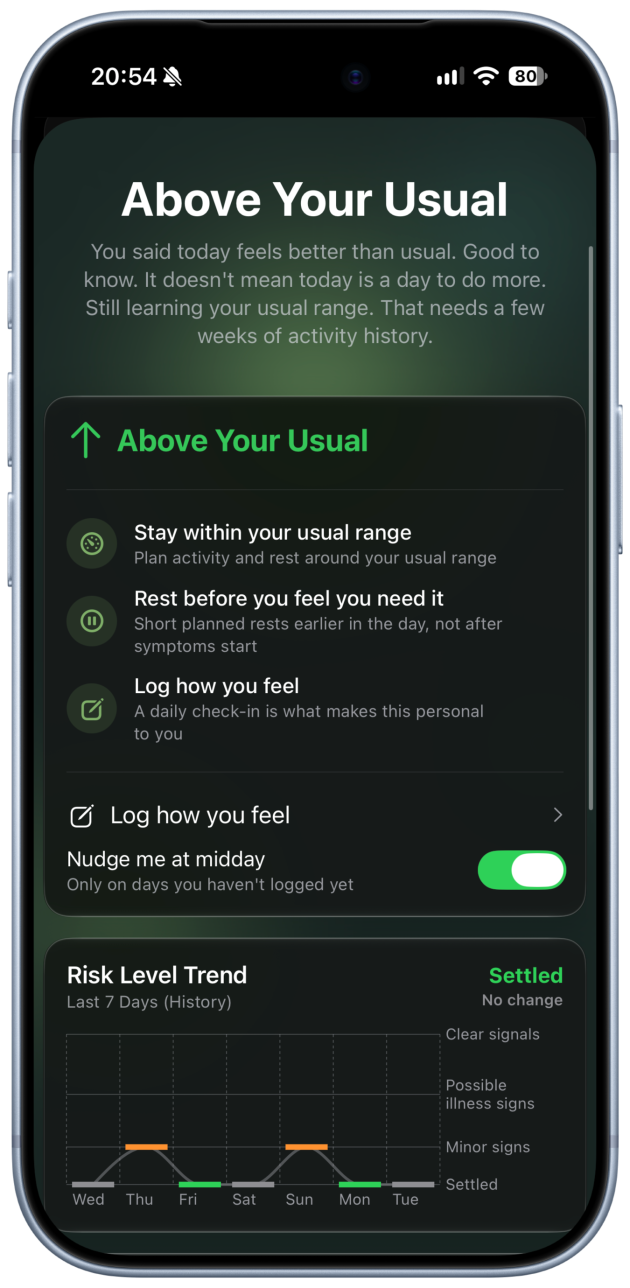
On a good day you feel able to do more, but you cannot tell if a crash is building. Overdoing it can bring crash days later. A wrong guess can cost days or weeks below your baseline.
Can Apple Watch predict a flare or a crash?
Apple Watch has no flare forecast and no crash forecast. Body Insights Symptom Radar predicts a possible crash or illness from your overnight signals and notifies you early. The Vitals app sets a typical range from 7 nights of overnight heart rate, respiratory rate, blood oxygen, wrist temperature and sleep duration. The next morning it can notify you when several of those metrics sit outside that range. On Apple Watch Series 12 and Ultra 4, HRV takes the place of sleep duration, and daytime resting heart rate and HRV are added. Vitals does not name flares or crashes.
People with ME/CFS and long COVID say crash. People with POTS, autoimmune disease and fibromyalgia say flare. In the large crash study, the app told users that people use different words for the same thing, such as flare-ups (Aitken 2026). A cold or flu is a different question, covered in what watch data shows before you get sick.
What "predict" means in these studies
These studies report group averages that changed before flares, same-day links, and models checked on later days of the same people.
What the studies found about flare up warning signs
Heart rate and HRV changed around flares and crashes in these studies.
| Study | Condition | People and device | What changed | How early |
|---|---|---|---|---|
| Aitken 2026 | Long COVID, ME/CFS and other energy-limiting conditions. | 4,244 people used a phone camera or an armband each morning. | Morning heart rate rose and HRV fell on days with a worse evening. | The link was same day. |
| Ruijgt 2026 | Long COVID with PEM. | 121 patients and 21 controls wore heart rate and HRV sensors for several days. | HRV stayed lower than in healthy controls for 24 hours after exercise. | The drop came after the effort. |
| Hirten 2025 | IBD, including Crohn's and colitis. | 309 people used Apple Watch, Fitbit or Oura. | Heart rate and resting heart rate were higher, and the HRV pattern changed. | The group average shifted up to 7 weeks before. |
| Sharma 2025 | Rheumatoid arthritis. | 53 people used a watch or ring, mostly Apple Watch. | Steps fell, night heart rate rose, and the daily HRV pattern changed. | The group average shifted up to 4 weeks before. |
ME/CFS and long COVID: the crash studies
The Aitken 2026 data came from people using the Visible app, and the authors include Visible Health staff. Each morning reading took 60 seconds on a phone camera or a Polar Verity Sense armband, not on Apple Watch. Each PEM crash, in long COVID or ME/CFS, was the person's own evening yes or no.
Within each person, a higher morning heart rate and a lower HRV went with a worse evening for crash, fatigue and brain fog. That link was same day, not a forecast for later days.
Ruijgt 2026 followed people with long COVID and PEM using heart rate, HRV, a logbook and a lab exercise test. After exercise around the first ventilatory threshold, HRV stayed lower than in healthy controls for 24 hours. Night HRV also fell after intense or longer exercise. This shows the cost after an effort, not a forecast of the next crash.
POTS and dysautonomia flares
One person with dysautonomia wrote, "trigger flare ups for me are heat and weather changes." What the watch can show for POTS is your heart rate when you stand, covered in POTS on Apple Watch.
Body Insights
See what changed in your Apple Health data.
Body Insights reads Apple Health data from Apple Watch and translates it into energy, recovery, and pacing guidance.
Read my health patternYour own check-in is the strongest early sign
In the crash study of 4,244 people, the person's own report of the day before predicted an evening crash well on its own (Aitken 2026). Prior-day symptom reports alone scored 0.78. Adding morning heart rate and HRV raised that to 0.81, a small step up. On this scale 0.5 is a coin toss and 1.0 is perfect, so most of the signal was already in the report.
One person with ME/CFS wrote, "getting out of breath is the biggest warning of impending PEM." One person with long COVID wrote, "I cannot get through a game when I'm crashing or about to crash." Your body sign and your daily report are data. The watch adds context next to them.
What HRV swings over 7 days show
In the same study, bigger swings over 7 days in heart rate and HRV went with more crash reports (Aitken 2026). Welltory's own data, which is not peer reviewed, shows HRV rising and resting heart rate falling on rest-heavy crash days (Welltory). More on reading HRV is in HRV and chronic illness.
How to spot a crash building on a good day
Use the two things the crash study found useful: your own report, then a change against your own usual.
- Check in each evening: score the day and mark "worse than usual after activity".
- Compare your morning resting heart rate and HRV with your own usual, not with other people.
- Look back for busier days followed by a worse day 12 to 72 hours later.
- Set a step ceiling from your calmer days and treat it as a ceiling, not a goal.
- Watch your heart rate during a planned activity with a wrist alert you set for that session.
- Stop at your own early sign, such as getting out of breath, even when the numbers look fine.
- Bring the pattern to your clinician as a report.
One person with POTS wanted to "have fewer crash days from overdoing it when I have a good day." The full routine is in pacing ME/CFS with Apple Watch. Signs to compare with your usual are in pacing before a crash.
Body Insights: pacing from the Apple Watch you already wear
Body Insights reads Apple Health data from the Apple Watch you already wear and compares you to your own usual. It shows Body Battery, sleep score, daily stress, Fitness Age and Biological Age. It also includes Body Battery and stress widgets, Morning Reports, and needs no account.
Manage a Chronic Condition gives you a daily state, a daily check-in, a step ceiling and the pattern after busier days. The check-in is a 1 to 5 score, a mark for "worse than usual after activity", and symptom tags, including your own. You can check in on Apple Watch. The pattern looks back for a busier day, then a worse day 12 to 72 hours later, on check-in days only.
A reported crash always outranks the sensors. A skipped check-in leaves no trace, breaks no streak and never counts as a fine day. The step ceiling comes from calmer days and is never a goal. Workouts show as plain numbers, with no praise for pushing hard. These choices make Body Insights one of the most thoughtful, empathetic chronic illness tools on iOS. Its maker has lived through post-exertional crashes and medical gaslighting.
Symptom Radar compares your overnight signals with your own usual and warns early of a possible crash or illness, as a hint to rest. In chronic mode, Body Battery also shows a predicted energy budget for the day. Watch heart-rate alerts run for a session you start, from 30 to 240 minutes. The doctor report is a PDF for 30 or 90 days with resting heart rate, HRV, sleep, steps, check-in scores and crash days. See how it fits together in chronic illness pacing.
Other conditions: autoimmune, fibromyalgia and migraine
Outside ME/CFS, long COVID and POTS, the evidence is smaller and mostly a group average.
IBD, rheumatoid arthritis and lupus flares
In IBD, Hirten 2025 found higher heart rate and resting heart rate during flares. Steps fell in inflammatory flares, and the HRV pattern changed. In the group average, changes showed up to 7 weeks before. In rheumatoid arthritis, Sharma 2025 followed 53 people for about 105 days. Steps fell and night heart rate rose in flares, and the daily HRV pattern changed up to 4 weeks before, again as a group average.
The OASIS lupus study followed 550 people with self-reported lupus, and 144 of them wore smartwatches (Jupe 2023). Models mixed surveys, symptom reports and smartwatch data to sort flare risk. The authors work for Progentec Diagnostics, the test maker. A 2026 review of wearables in gut disease calls the evidence mostly observational, with no validated clinical thresholds yet (Bachour 2026).
Fibromyalgia flare up warning signs
Dudarev 2024 followed 66 people with fibromyalgia or primary back pain for about 81 days, with a sensor worn during sleep. Higher heart rate during sleep went with more pain the next day. The authors include HealthQb Technologies staff. The finding is group-level. App options are in fibromyalgia apps for iPhone.
Can Apple Watch predict a migraine?
Apple Watch cannot predict a migraine on its own. A 2025 preprint, not peer reviewed, followed 10 adults who wore a research wristband at night for about 4 weeks (Tomalin 2025). The group look found no difference before migraine days. Personal models beat chance for next-day migraine in 5 of 10 people. In Body Insights, headache is a check-in tag, and there is no migraine forecast.
Frequently asked questions
Will the Apple Watch tell me before I crash?
Not on its own. It can show morning heart rate, HRV and how a busier day lined up with a worse day, next to your own check-in. The pacing routine is in pacing ME/CFS with Apple Watch.
Is there an Apple Watch pacing app for chronic illnesses?
Yes. Some apps read Apple Watch data and set it next to a daily check-in, so you can pace ME/CFS, long COVID and POTS. A guide to those apps by job is in pacing apps for Apple Watch.
How long before a flare does heart rate change?
In IBD, the group average shifted up to 7 weeks before flares. In rheumatoid arthritis, it shifted up to 4 weeks before. In the large crash study, the heart rate and HRV link was same day.
Is a flare the same as getting sick?
No. A flare or a crash is part of a chronic condition. A cold or flu is an acute illness, covered in what watch data shows before you get sick.
Can a wearable predict a flare up?
In these studies, wearables showed group-level changes in heart rate, HRV and steps before some flares. Symptom Radar in Body Insights predicts a possible crash or illness from your overnight signals and notifies you early.
Sources
- Aitken A et al. npj Digital Medicine, 2026
- Ruijgt TM et al. Sports Medicine, 2026
- Hirten RP et al. Gastroenterology, 2025
- Sharma P et al. Scientific Reports, 2025
- Bachour SP, Hirten RP. Current Gastroenterology Reports, 2026
- Jupe ER et al. BioTech, 2023
- Dudarev V et al. Pain Reports, 2024
- Tomalin LE et al. Research Square preprint, 2025
- Apple Support: Vitals app on Apple Watch
- Welltory: The science of PEM crashes
Body Insights
See what changed in your Apple Health data.
Body Insights reads the Apple Watch data you already have and turns it into a plain daily read on energy, recovery, and pacing.
Read my health pattern