Heart Age trend
Your heart age month by month over six months, with the gap to your real age. A falling line means your heart age is moving younger, a rising line means older, a flat line means steady.

Heart Age · From your resting pulse
See your heart age in years next to your real age, learn what moves it, and watch the six-month trend show which way it goes.
The heart age calculator in Body Insights shows your heart age in years, taken from your Apple Watch. A resting heart rate lower than people of your age and sex gives a younger heart age.
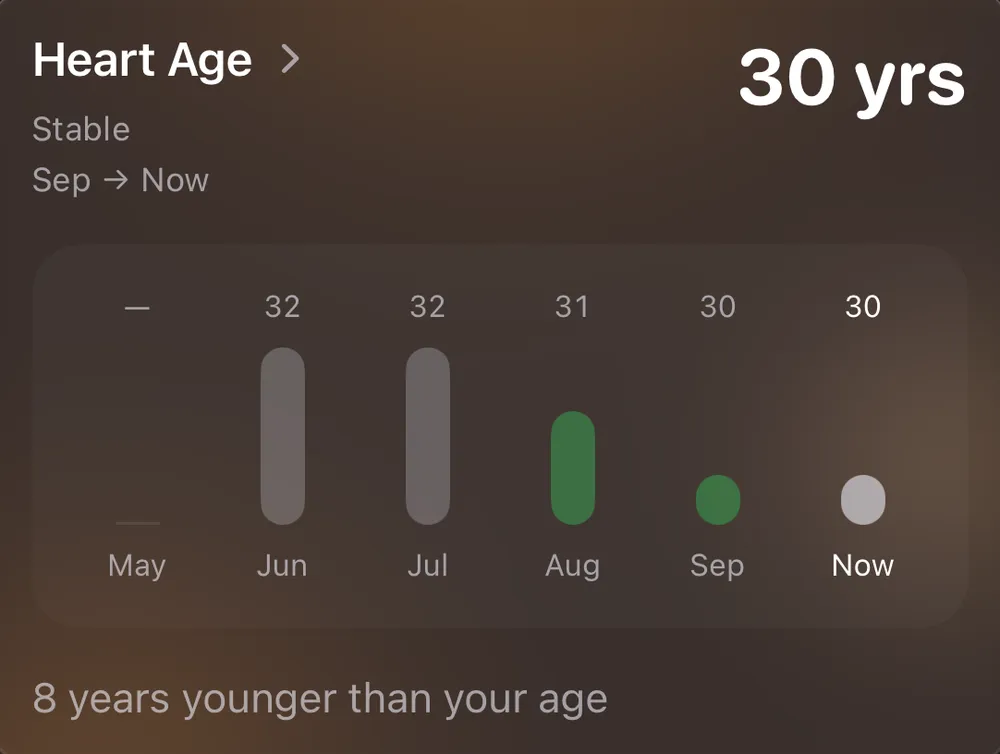

Heart age is your resting heart rate shown as an age in years. Body Insights takes your resting heart rate from Apple Health and averages the latest seven days. It compares that average with people of your age and sex. You see your heart age and how far it sits from your real age: a heart age of 30 for a real age of 38 reads as eight years younger.
A heart age younger than your real age is the good result: your resting heart rate is lower than people of your age and sex. Three numbers in the Heart Age detail show where you stand. Your 7-day average is the resting heart rate behind your age. Your 90-day lowest and highest show your range over three months, so you see whether this week sits near your best or your worst. Your age-group ranking shows where your resting heart rate falls among people of your age and sex.
Training, sleep, alcohol and illness all move your resting heart rate, and Heart Age follows them. Research puts numbers on two of them. In a review of trials in physically inactive adults, one year of running lowered resting heart rate by 6.7 beats per minute (95% CI 3.0 to 10.3). In a study of 20,968 people, one drink more than a person's own average went with a nightly resting heart rate 2.8 bpm higher in women and 2.4 bpm higher in men.
Your figure is a seven-day average. A hard week, a run of late drinks or an illness shows within the week and fades as those days roll out. The running result took a year, so expect the six-month trend to move slowly. Try this week:
The Heart Age detail shows your heart age against your real age and the six-month trend, where lower is better. It also gives your age-group ranking and your 7-day average with the 90-day lowest and highest. Heart Age can also tell you when it shifts: a move of two years sends one morning message, at most once a week, saying whether your heart age eased, nudged up or is holding. Turn it on in notification settings.
Your heart age month by month over six months, with the gap to your real age. A falling line means your heart age is moving younger, a rising line means older, a flat line means steady.
The resting heart rate behind your age, not your newest single reading.
The range your resting heart rate has covered over three months. Where your 7-day average lands inside it shows how the latest week compares with the quarter.
Where your resting heart rate sits among people of your age and sex.
To read the trend, compare the first month with the last, then look at the direction between them.
Body Insights shows four ages on the Trends tab.
| Age | Reads |
|---|---|
| Heart Age | Your resting heart rate |
| Fitness Age | Your Cardio Fitness, or VO2 max |
| Nervous System Age | Your heart rate variability |
| Sleep Age | Your habitual sleep |
Use Heart Age for week-to-week signals from sleep, alcohol, illness and training. Use Fitness Age for the longer fitness picture that Cardio Fitness gives you. Nervous System Age and Sleep Age cover heart rate variability and habitual sleep.
Heart Age compares your seven-day average resting heart rate with people of your age and sex, so the number follows your week, not one morning.
Body Insights reads your resting heart rate from Apple Health and shows a heart age.
Heart Age compares your average resting heart rate over the latest seven days with people of your age and sex, then shows the result in years.
Heart Age reads resting heart rate. Fitness Age reads Cardio Fitness. The two numbers move for different reasons.
Your seven-day average resting heart rate sits above people of your age and sex. Check recent sleep, alcohol, illness and training, then look at the 90-day range and the six-month trend.
Heart Age appears after seven days of resting heart rate from your Apple Watch. Until then it counts your days from 1 to 7.
On-device. No account. No data sold. Ever.